


Introduction
The title of this exhibition is the common response to a compliment directed towards a dress, skirt, or other garment that is typically designed without pockets. Beyond the surface of this ubiquitous phrase is a centuries’ long history in which women’s clothing has been denied the functionality, portability, and privacy of pockets. This history—literally hidden within a garment—is entangled in broader issues related to property ownership, access to public space, and a binary system of gendered clothing.
Pockets are political. While pockets were integrated in European menswear by the late fifteenth century, women wore detachable pockets that were less secure under their skirts until the nineteenth century. In 1901, American activist Elizabeth Cady Stanton underscored the necessity of pockets in women’s clothing as a question of morals, rather than a question of fashion. Pockets could be intentionally withheld from the clothing of enslaved peoples “not just out of a desire for economy but as a sort of preemptive disciplinary strategy.”1 On the other hand, pockets have been essential throughout history to those required to carry documentation related to their status.
Following their proliferation in the mid-twentieth century, pockets are no longer exclusively functional. The pockets in this exhibition can be situated on a spectrum ranging from function to fashion. Despite the increased availability of pockets today, the enduring echoes of “thanks, it has pockets” suggests this simple application of cloth is a source of agency, autonomy, and joy.
Attached
Prior to the late fifteenth century, precious portable possessions were typically carried in purses attached to the body by both men and women. Pockets integrated into garments offered greater security than detachable and external purses. The voluminous breeches and increasingly long jackets worn by European men from the late fifteenth century onwards offered the space and structure for internal pockets.
There is evidence that women of very high status, such as Queen Elizabeth I (1533-1603), ordered gowns with integrated pockets.2 However, the pockets experienced by most women in early modern Europe and America were separate “tie-on pockets.” These pockets were worn under one or multiple layers of skirts, secured to the waist, and accessed through slits in the outer gown. The average tie-on pocket measured approximately 12 inches wide by 16 inches long.
Due to their proximity to the body, tie-on pockets kept valuables close. They offered privacy at a time when housing was crowded and cramped. Moreover, pockets facilitated experiences of possession under the legal framework of “coverture,” which prohibited married women from independently owning property, including personal effects.3 Making, decorating, and using pockets to carry the essential tools of domestic labor aligned with prescribed gender conventions.4 At the same time, pockets were essential accessories to women’s “increasing mobility and independence” in the eighteenth and nineteenth centuries.5
All pocket measurements are listed as length by height, including those for non-rectangular shapes. Scale illustrations of select pockets are included on the walls throughout the gallery. Pockets measured and illustrated by Sunny Collins, Apparel Merchandising Student (Senior), Colorado State University.
1. Recreation of Nineteenth-Century Tie-On Pockets, Cotton, Created by Anna Swalm and Sunny Collins. Pocket dimensions: 8.75 x 15.5 inches.
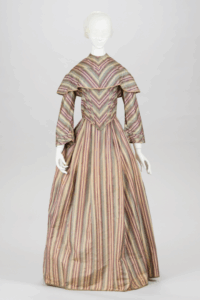
2. Skirt, c. 1850, Silk, Donor: Esther Cornell, Avenir Museum no. 2012.110b. Pocket dimensions: 14.5 x 4.5 inches.
3. Skirt by Róhe [Netherlands, founded 2021], 2024, Cotton, Loan: Paula Alaszkiewicz. Pocket dimensions: 7.5 x 10.25 inches.
4. Side Seam Pocket, c. 1880, Cotton and Silk, Avenir Museum no. 2000.050. Pocket dimensions: 13 x 3.5 inches.
5. (Left) Purse, c. 1890-1910, Metal, Donor: Kathy McDonald, Avenir Museum no. 2023.14.1. Dimensions: 3 x 5 inches.
(Center) Purse, c. 1900, Metal, Donor: Helen Prout, Avenir Museum no. 2001.44. Dimensions: 2.75 x 2.5 inches.
(Right) Purse, c. 1910, Metal, Donor: Ostertag, Avenir no. 73.3.219. Dimensions: 5 x 5 inches.
Tubular gowns made of thin cotton that were fashionable in the late eighteenth and early nineteenth centuries were incompatible with integrated or tie-on pockets. As a result, women carried their possessions in small pocket-shaped handbags. Historically, these handbags were called “reticules,” and sometimes “ridicules,” because handbag-carrying women were subject to criticism for so blatantly carrying belongings with them.
6. Chatelaine, Nineteenth Century, Metal, Loan: History Colorado.
The name for this peculiar object, chatelaine, refers to the lady of the castle [chateau]. Chatelaines were popular accessories in the second half of the nineteenth century. They combined the fashionability of jewelry with the practicality of a Swiss Army Knife. Chatelaines were attached at the waist like a brooch to provide easy access to “various articles of domestic use.”6 This example includes a mirror, a sleeve for scissors, a retractable pencil, and an erasable shopping list with pages for each day of the week.
Hidden
Numerous nineteenth-century bodices in the Avenir Museum collection have small pockets hidden in their interior. Safely located between the body and the exterior garment as the threshold to the outside world, these pockets represent a spatial zone “invested with emotions […] where intimate relationships are located.”7 Interior and other small inconspicuous pockets were the ideal place to store sentimental mementos such as lockets, miniature portraits, locks of hair, and rings because of how the “physical proximity of the object mirror[ed] the emotional proximity between donor and recipient.”8
7. Linen and Lace Blouse, c. 1930, Linen, Donor: Judy Graise, Avenir Museum no. 2018.26.4. Pocket dimensions: 2 x 2 inches.
Avenir Museum records date this blouse to the 1930s; however, its primary stylistic influence is eighteenth-century menswear. This design is not typical of the 1930s and may have been created as costume, rather than fashionable dress.
Home
In the early twentieth century, the fight for functional pockets in women’s clothing intersected with the suffrage movement. Without pockets, women were required to carry their possessions in their hands and handbags. This, according to suffragist Elizabeth Cady Stanton, exposed women to theft, accidents, and other dangers. Opponents viewed women’s pockets as masculine, unnecessary, and likely to disrupt the intended line of the idealized silhouette.
From the 1910s onwards, pockets were added to the humble clothing worn in the privacy of the home. The inclusion of pockets on aprons, smocks, and house dresses rendered the garments worn for domestic labor more functional. Since women’s clothing worn in public was subject to debate and criticism, the privacy of the home provided an arena for women’s pockets that was less visible, and therefore less controversial.
8. Maternity Smock, c. 1930, Cotton, Donor: Margaret Wallace, Avenir Museum no. 2018.45.15. Pocket dimensions: 3 x 3 inches.
9. Apron, c. 1940, Cotton, Donor: Dorothy Pughe Klinger, Avenir Museum no. 80.8.44. Pocket dimensions: 7.25 x 6.5 inches.
Dress, c. 1940, Cotton, Donor: Eileen Lyons, Avenir Museum no. 2013.41.03a.
10. Dress by Claire McCardell Clothes by Townley [United States, founded 1940], c. 1950, Cotton, Avenir Museum no. 2018.54.0. Pocket dimensions: 11 x 6 inches.
The designer Claire McCardell (1905-1958) belonged to a new generation of American women designers who have been celebrated for, amongst other accomplishments, making “visible, spacious” and “purposefully conspicuous” pockets.9 This design ethos is exemplified by the large patch pocket on McCardell’s celebrated “Pop-Over” dress from 1942. This McCardell dress in this section is a later iteration of a fashionable house dress and includes a generous, yet hidden, side seam pocket. For McCardell, pockets were not exclusively functional. They also had “the psychological benefit of giving a woman a place to put her hands.”10
Suiting
The origins of the standard three-piece suit can be traced to 1666, when King Charles II of England (1630-1685) introduced a new style to be worn at court: breeches, a sleeveless waistcoat (or vest) influenced by Middle Eastern dress, and a knee-length jacket. With this shift, pockets “migrated from breeches to coats and waistcoats—the point when their proliferation began in earnest.”11 By the late seventeenth century, horizontal pocket flaps could be found on waistcoats and jackets alike.
Despite subsequent evolutions in style, suiting has undoubtedly maintained a “pocket monopoly.”12 The elongated skirts of nineteenth-century tailcoats and frockcoats, such as Object 11, provided ample space for large pockets—some evident and some inconspicuous. Invisible interior pockets, still routinely included in vests and jackets, offer ultimate portability, privacy, and security.
11. Men’s Riding Jacket by W. Auchinachie Aberchirder, c. 1900, Wool, Donor: Margaret Fillmore, Avenir Museum no. 89.43.6. Pocket dimensions: front interior 6 x 7 inches; back 7 x 11.5 inches.
12. Waistcoat, c. 1890, Silk, Cotton, and Suede, Donor: Donna Wahlen, Avenir Museum no. 91.489b. Pocket dimensions: upper 3.5 x 3.5 inches; lower 4.25 x 3 inches.
13. American Red Cross Uniform, c. 1946-1948, Wool, Donor: George Valley and Chris Guffy, Avenir Museum no. 2013.22.002. Pocket dimensions: upper 5 x 5.25 inches; lower 7 x 7.5 inches.
14. Leisure Suit Jacket by Johnny Carson [United States, founded 1970], c. 1975-76, Synthetic, Donor: Brian Dunbar, Avenir Museum no. 2025.7.1 Pocket dimensions: upper 4.75 x 5.5 inches; lower 6.75 x 9 inches; interior 5.5 x 5 inches.
Leisure Suit Trousers, c. 1970, Cotton, Donor: Barbara Beckley Heffington, Avenir Museum no. 2019.21.08. Pocket dimensions: front 4 x 11.5 inches; back 4 x 7 inches.
15. Suit by Yves Saint Laurent [France, founded 1961], c. 1980, Wool and Silk, Avenir Museum no. 2002.066. Jacket pocket dimensions: upper 4 x 5 inches; lower 6 x 7 inches; upper left interior 4 x 4.5 inches; lower left interior 5 x 6.5 inches; lower right interior 5.25 x 7 inches. Trousers pocket dimensions: 6.5 x 11.5 inches.
Tie by Mr. Blackwell [United States, founded 1958] c. 1970, Synthetic, Donor: Richard Blackwell and Robert Spencer, Avenir Museum no. 962.20c.
16. Suit Ensemble by Richard Tyler [United States, founded 1985], 1990, Wool, Synthetic, Donor: Estate of Victoria Manfort, Avenir Museum no. 2010.42. Jacket pocket dimensions: interior 5 x 11 inches. Trousers pocket dimensions: 5.25 x 5.75 inches.
Objects 15 and 16 represent opposing approaches to pockets. The men’s suit jacket contains six functional pockets, including three interior pockets. The women’s suit jacket, in contrast, has only one functional pocket. This lone pocket, hidden away in the interior, has a vertical opening that is far less secure than the horizontal openings used for every pocket in the men’s jacket. This juxtaposition is evidence of a continued gendered discrepancy in pocket availability and functionality some ninety years on from Elizabeth Cady Stanton’s appeal for pockets in women’s clothing.
17. Bernard Rudofsky, Are Clothes Modern? An Essay on Contemporary Apparel (Paul Theobald, 1947).
The exhibition Are Clothes Modern? opened at the Museum of Modern Art (MoMA) in 1944. Curated by the architect-designer-historian Bernard Rudofsky (1905-1988), the exhibition questioned the “useless, impractical, irrational, harmful and unbeautiful” conventions of clothing. Pockets and buttons, according to Rudofsky, exemplified the “degeneracy of functional clothing.”14 In the 1940s, a man dressed in a shirt, suit, and overcoat had access to two dozen pockets. Rudofsky took issue with this excess, explaining: “the perfectly legitimate and helpful institution of the pouch as attached to the garment in the form of a pocket, goes rampant until, through its overgrowth, the original scope gets lost, and it ends up in decorative silliness.”15
Suiting II
This section features three skirt suits from the period during and immediately following the Second World War (1939-1945). Wartime roles, responsibilities, and rationing brought about a reappraisal of women’s fashionable dress. Conventions of men’s suiting were adapted into skirt suits worn as service uniforms, such as the American Red Cross uniform (Object 13), or as fashionable dress on the home front. In addition to being practical and functional, the wartime skirt suit represented “the authority and sense of purpose invested in a business suit.”16 While the pockets in the jackets of these three examples are functional, their unconventional shapes signal the coexistence of fashion and function.
18. Skirt Suit by Chas A. Stevens & CO [United States, founded 1886], c. 1940, Wool, Donor: Mary K Linger, Avenir Museum no. 92.143. Pocket dimensions: upper 3.25 x 2.5 inches; lower 4.5 x 3 inches.
19. Skirt Suit made from a Vogue pattern, 1940, Wool, Donor: Lucille Anderson, Avenir Museum no. 81.4.1. Pocket dimensions: 4 x 4 inches.
20. Skirt Suit by Rothmoor [United States, founded 1924], c. 1950-1955, Worsted Wool, Donor: Dagmar Gustafson, Avenir Museum no. 78.32.66. Pocket dimensions: upper 5.5 x 5 inches; lower 0x0 inches.
Found
A twenty-dollar bill. An earring. A key. The joyful surprise of finding something previously considered lost in the depths of a pocket is a unique feeling. The objects in this vitrine were found in the pockets of three garments in the Avenir Museum Collection.
What is your most memorable pocket find? Please add it to the list to the right of the vitrine.
21. Objects found in pockets in Avenir Museum no. 89.13.5; 85.60.2A; 2012.183b.
Function
Pockets are an essential component of garments worn for occupational and physical labor. Patch pockets, made by sewing a separate piece of fabric to a garment, “originated in workwear.”17 Pockets for tools were added to overalls in the nineteenth century.18 By 1917, the “Union-All” coveralls made by H.D. Lee Mercantile (which later became the Lee brand) included eight pockets. A 1924 advertisement dubbed the eight-pocket coveralls as the “farmer’s friend.” Since the mid-twentieth century, durable clothing with functional pockets such as denim jeans and cargo pants have progressively moved from the factory, farmer’s field, and front line to the fashion arena.
22. Cargo Pants by Macgear [United States, founded c. 1998], c. 2000, Synthetic, Donor: Paula Alaszkiewicz, Avenir Museum no. 2025.25.1. Pockets dimensions: side seam 8.25 x 7.25 inches; outer waist 2.5 x 3 inches; inner waist 3.25 x 3.75 inches; back 8 x 9 inches.
Sweatshirt by Quicksilver [United States, founded 1976], 1997, Cotton, Loan: Rhett Osborne. Pocket dimensions: 12 x 7 inches.
Trousers with functional pockets on the sides of the legs were developed by a Lieutenant General in the United States Army during the Second World War.19 So-called “cargo pants” were initially worn as civilian dress in the 1970s, when garments from army surplus stores were adopted by subcultural movements. In the 1990s, the cargo pant entered mainstream fashion and became widely available from fast fashion brands, outdoor retailers, and luxury designers alike. The cargo pants featured in this section perfectly represent the confluence of hip hop, skater, and utility influences in late 1990s style that has recently become fashionable again. Including an interior envelope pocket, these cargo pants have ten pockets that offer a combined 308 square inches of storage.
23. Ensemble by Wayne Rogers [United States, founded 1970], 1977, Cotton, Donor: Jean Raney, Avenir Museum no. 91.235. Blouse pocket dimensions: upper 2 x 4 inches; lower 4 x 5 inches. Trousers pocket dimensions: upper 4 x 3.5 inches; middle 3.25 x 3 inches; lower 2.75 x 2.5 inches.
24. Homemade Patchwork Denim Jacket, 1972, Cotton, Donor: Karen Kruse, Avenir Museum no. 2016.47.39. Pocket dimensions: left 1.5 x 6.25 inches, right 1.5 x 2.25 inches.
Denim Jeans by Levi Strauss & Co. [United States, founded 1853], 2025, Cotton, Avenir Museum Purchase, Avenir no. 2025.22.1. Pocket dimensions: front 6.5 x 5.5 inches; inner front 3.25 x 4 inches; back 6 x 5.75 inches.
In 1873, Levi Strauss & Co. successfully filed a patent for rivet-reinforced denim jeans. The patented design featured four pockets: two front pockets—one of which contained a smaller watch pocket—and one patch pocket on the back. The additional back pocket was added in 1901, thus establishing the enduring standard of five-pocket denim. 20
25. Denim Jeans by Rogue Territory Denim [United States, founded 2009], 2015, Cotton, Loan: Peter Newman. Pocket dimensions: back 6.25 x 6 inches; inner back 1.25 x 5.25 inches; front 6 x 6.25 inches; inner front 3.5 x 1.5 inches.
These jeans were made from raw denim, meaning denim that was not washed, distressed, or otherwise treated. With repeated wear and use, raw denim eventually reveals signs of its wearer in the form of faded “whiskers” around the fly or “honeycombs” behind the knees. Wallets, phones, and keys regularly stored in the same pocket will also inevitably leave a mark called a “fade.” This pair was worn approximately one hundred times—enough for the wearer’s wallet to form a distinct fade on one of the rear pockets.
26.Denim Overalls by Big Mac [United States, founded 1922], c. 1950, Cotton, Donor: June Kissock, Avenir Museum no. 2018.41.06. Pocket dimensions: upper center 9.5 x 6 inches; side seam 5.5 x 11 inches; right pocket within side seam pocket 3 x 3 inches; lower right 3 x 9 inches; lowest right 3 x 5.5 inches; back 6.75 x 8 inches.
Shirt by American Eagle [United States, founded 1977], 1997, Cotton, Loan: Rhett Osborne.
Back/Pack
The idiomatic phrase “keeping something in your back pocket” suggests a plan, idea, or strategic move being held in wait for the perfect moment. The three ensembles in this section have pockets placed on the back of their front-closing jackets. This provides ample space for storing objects that do not require easy access. The red hunting jacket (Object 29) features a hidden back pocket that measures 20 inches wide by 9 inches tall—the perfect size for storing a pheasant while on a hunt. — Written by Brooklyn Wenzel
27. Ensemble by Bonnie Cashin [United States, founded 1953], c. 1970, Cotton and Leather, Donor: Renata Stanton, Avenir Museum no. 2022.5.6. Pocket dimensions: front 6 x 11 inches; back 13.5 x 11.25 inches.
28. Ensemble by Bonnie Cashin [United States, founded 1953], c. 1970, Leather, Donor: Renata Stanton, Avenir Museum no. 2022.5.3. Pocket dimensions: 6.5 x 8.25 inches.
The career of American sportswear designer Bonnie Cashin (1908-2000) included designing ready-to-wear, costume and uniforms, and accessories. In 1940, frustrated by the lack of pockets in women’s clothing, Cashin asked her mother to sew a purse onto her coat. Garments with an integrated kiss-clasp pouch became a signature Cashin design; in 1950 she patented the “hands-free purse-pocket.”21 Another Cashin hallmark—the brass toggle closure—is visible on both pieces in this section. Cashin also utilized this distinctive closure on the leather goods and accessories she oversaw as the first lead designer for Coach from 1962 to 1974.
29. Hunting Jacket by JCPenney [United States, founded 1902], c. 1950, Wool, Donor: Michael Gorgan, Avenir Museum no. 2016.50. Pocket dimensions: front upper 6 x 6 inches; front lower 7.5 x 8 inches; back 20 x 9 inches.
Men’s Jeans by Rigolletto [United States, founded c.1978], Second Half of Twentieth Century, Cotton, Donor: Barbara Beckley Heffington, Avenir Museum no. 2019.21.17. Pocket dimensions: front 5 x 7 inches; front inner 4.5 x 2.5 inches; back 5.5 x 6.25 inches.
To What End?
The three ensembles in this section are made from thin, delicate fabrics. Although each ensemble has a functional pocket, we simply ask: why? To what end?
30. Dress, c. 1920, Silk, Avenir Museum no. 2004.192. Pocket dimensions: 2.75 x 2.75 inches.
31. Blouse by James Galanos [United States, founded 1952], 1974, Silk, Donor: Marianne Kline, Avenir Museum no. 99.3. Pocket dimensions: 4 x 5 inches.
Skirt by James Galanos [United States, founded 1952] c. 1980, Silk, Donor: Marianne Kline, Avenir Museum no. 2002.010.
32. Dress with Attached Cardigan, 1934, Synthetic, Donor: Ostertag, Avenir Museum no. 73.3.84. Pocket dimensions: 3.75 x 3.5 inches.
Deceit
The deception of a fake pocket fosters impassioned emotional responses, including frustration, anger, and disappointment. Fake pockets were popularized in the mid-twentieth century, just as functional pockets were finally readily integrated in womenswear. Two reasons are commonly used to justify fake pockets. First, a functional pocket that is used to carry objects may bulge and buckle, therefore disrupting the intended line of the silhouette. Second, pockets increase the time and cost of manufacturing. The rise of fast fashion has exacerbated the prioritization of cost savings and efficiency over functionality and quality.22 If a pocket is fake, is it inherently a statement of fashion over function?
33. Dress by Neusteters [United States, founded 1924], 1967, Wool, Polyester and Leather, Avenir Museum no. 79.23.3.
34. Dress, c. 1965, Wool, Donor: Marcia S. Chuallie Fogel and Vicki Fogel Mykles, Avenir Museum no. 2010.284.
35. Coat by James Galanos [United States, founded 1952], c. 1960, Wool, Donor: Marianne Kline, Avenir Museum no. 2010.33.
36. Dress by Elite Frocks, 1940, Synthetic, Donor: Daryl Wulff, Avenir Museum no. 2003.10.
37. Silk Waistcoat, c. 1790, Silk, Donor: Margaret Wallace, Avenir Museum no. 2025.13.3.
This embroidered silk waistcoat represents one-third of the three-piece suit formula. Throughout the eighteenth century, ornate embellishment and luxurious trims adorned pocket flaps, thereby transforming this “functional” detail into a site of fashion. The embroidered pocket flaps on this waistcoat are further aligned with fashion due to their non-functional status.
Fashion
In this final section, the practical pocket becomes a design element that celebrates—at long last—the triumph of the pocket in womenswear. Far from the humble pocket hidden inside a garment, these oversized, unconventionally shaped, and irregularly placed pockets are highly visible on the garment exterior. The various fabrics in use in this section provide differing levels of structure for a functional pocket. Fabric, size, shape, and placement contribute to whether a pocket’s priorities align with fashion, function, or both. However, it ultimately the wearer who determines the potential of their pockets.
38. Coat by James Galanos [United States, founded 1951], 1992, Wool, Donor: Marianne Kline, Avenir Museum no. 2017.33.1. Pocket dimensions: 9.75 x 9.75 inches.
39. Coat, c. 1930, Mohair and Silk, Donor: Pamela Smith Hill, Avenir Museum no. 89.45.2. Pocket dimensions: 8 x 10.5 inches.
The oversized teardrop-shaped patch pockets on this coat were the inspiration for this exhibition. These pockets are undoubtedly the primary decorative feature of this fashionable coat, yet they are also functional. This piece exemplifies how fashionable dress can successfully incorporate functional pockets, and therefore support the agency, autonomy, and mobility of its wearer.
40. Coat, 1960, Wool and Synthetic, Donor: Marcia S Churallie Fogel and Vicki Fogel Myrles, Avenir Museum no. 2010.368. Pocket dimensions: 6.25 x 5.5 inches.
41. Dress by Herbert Sondheim [United States, founded 1923], c. 1950, Wool, Donor: Lilla Morgan, Avenir Museum no.79.9.7A&B. Pocket dimensions: 12.75 x 9.5 inches.
42. Dress by Thierry Mugler [France, founded 1974], c. 1990, Acetate and Viscose, Avenir Museum no. 2018.55.02. Pocket dimensions: 4 x 7.75 inches.
43. Trousers by Yves Saint Laurent Rive Gauche [France, founded 1966], 1985, Wool, Donor: Francis Valette, Avenir Museum no. 2012.171. Pocket dimensions: 7 x 8 inches.
44. Evening Dress by Mr. Blackwell [United States, founded 1958], c. 1960, Silk, Donor: Lum and Montez Jenkins, Avenir Museum no. 87.15.4. Pocket dimensions: upper 7.75 x 6.25 inches; middle 9.25 x 7 inches; lower 9.25 x 7 inches.
Object Located in Museum Lobby
45. Reversible Dress by Lida Aflatoony, PhD, Assistant Professor of Product Development, Design and Merchandising, Colorado State University, Wool, 2016, Lender: Lida Aflatoony.
Both sides of this reversible dress include four inseam pockets: two on the front and the two on the back. This garment was designed for individuals with vision impairment. It uses tactile design strategies in the form of padded shapes to guide the wearer to locate the pockets.
References
[1] Hannah Carlson, Pockets: An Intimate History of How We Keep Things Close (Algonquin Books, 2023), 56.
[2] Rebecca Unsworth, “Hands Deep in History: Pockets in Men and Women’ Dress in Western Europe, c. 1480-1630,” Costume 51, no. 2 (2017): 156.
[3] Barbara Burman and Ariane Fennetaux, The Pocket: A Hidden History of Women’s Lives (Yale University Press, 2019), 136.
[4] Fennetaux, “Women’s Pockets and the Construction of Privacy in the Long Eighteenth Century, Eighteenth-Century Fiction 20, no. 3 (2008): 311-315.
[5] Fennetaux, “Women’s Pockets,” 315.
[6] Valerie Cumming, C.W. Cunnington, and P.E. Cunnington, The Dictionary of Fashion History (Bloomsbury, 2017), np. DOI: 10.5040/9781474269728.596.
[7] Fennetaux, “Women’s Pockets,” 327.
[8] Ibid.
[9] Richard Martin cited in Carlson, Pockets, 129.
[10] Elizabeth Evitts Dickinson, Claire McCardell: The Designer Who Set Women Free (Simon and Schuster, 2025), 45.
[11] Carlson, Pockets, 49.
[12] Ibid., 74-75.
[13] The Museum of Modern Art, Press Release, “Museum of Modern Art to Open Exhibition Art Clothes Modern?,” https://assets.moma.org/documents/moma_press-release_325447.pdf
[14] Bernard Rudofsky, Are Clothes Modern? An Essay on Contemporary Apparel (Paul Theobald, 1947), 126.
[15] Rudofsky, Are Clothes Modern?, 126.
[16] Geraldine Howell, Wartime Fashion: From Haute Couture to Homemade, 1939-1945 (Berg: 2012), 72.
[17] Carlson, Pockets, 190.
[18] Djurdja Bartlett, “Overalls: Functional, Political, Fashionable,” in Uniform: Clothing and Discipline in the Modern World, eds. Jane Tynan and Lisa Godson (Bloomsbury: 2019), 201.
[19] Joseph Hancock II and Eward Augustyn, “Pants, Trousers” in Berg Encyclopedia of Dress and Fashion: Global Perspectives, edited by Joanne B. Eicher and Phyllis G. Tortora (Berg, 2010), np. DOI: 10.2752/BEWDF/EDch10211.
[20] Tracey Panek, Levi Strauss & Co., “The Story Behind the Official Fifth Pocket,” May 3, 2021, https://www.levistrauss.com/2021/05/03/the-story-behind-the-official-fifth-pocket.
[21] Carlson, Pockets, 130-131.
[22] Carlson, Pockets, 134-35.