


Acknowledgements
This exhibition is a joint project between the Avenir Museum of Design and Merchandising and the C. P. Gillette Museum of Arthropod Diversity. Thank you to the C. P. Gillette Museum and Museum Director Marek Borowiec for the generous loan of insect specimens, and the time and effort of their staff and volunteers. A particular thank you to Laila Paluszek, Insect Consultant and Graphic Designer and to Leo Liu, Insect Consultant and Diorama Fabricator from the C. P. Gillette Museum.
Thank you to Avenir Staff for additional assistance:
Paula Alaszkiewicz, Curator
Megan Osborne, Director of Engagement and Operations
Sarah Lillis, Education Coordinator
Brooklyn Wenzel, Visitor Engagement Coordinator
All labels with an asterisk are by Leo Liu.
Unmarked labels are written by Gabrielle Friesen, Collections Database Coordinator, and Paula Alaszkiewicz, Curator and Assistant Professor, on behalf of the Avenir Museum.
Insect diagrams are by Laila Paluszek.
All insect photographs are sourced from iNaturalist, a community science site, and are used under Creative Commons licenses. No edits have been made to iNaturalist photographs.
Introduction
Humans have used insects as sources of fiber, dyestuffs, and inspiration for thousands of years, creating an inextricable link between textiles and insects. However, both clothing and insects are often overlooked despite playing important roles in our natural and social environments. This exhibition explores how insects make the world of fashion possible.
From the silk of moths leading to global systems of trade via the Silk Roads, to the dye of cochineal bugs becoming an object of colonial desire and extraction, insects and textiles are present in some of the largest moments in human history. Insects are also influential in fashion fads, as in the Victorian beetle craze for living jewelry. They haunt our closets as pests; they charm and delight, inspiring material, pattern, and adornment. Insects aid clothing in shaping human social environments, by adding to the range of colors, materials, and designs used by people to signal something about themselves.
No matter the personal feeling insects may instill, they deserve celebration and recognition for shaping our shared landscapes and enriching our lives, for insects have always been in and on our cloth.
What is a Textile?: A textile is any fabric or material made by combining organic or synthetic fibers to create structure. Textiles play important roles in the economy, human history, and self-expression.
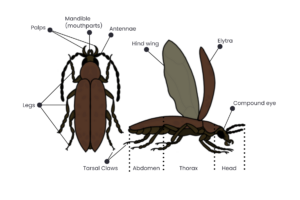
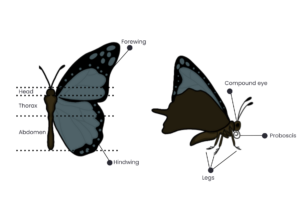
What is an Insect?: An insect is an invertebrate animal with a hard exterior exoskeleton and three body segments: the head, thorax, and abdomen. Insects have antennae, compound eyes, one or two pairs of wings, and three pairs of jointed legs. Insects are important to the environment as pollinators, cleaners, and food for a vast community of species.
The C.P. Gillette Museum of Arthropod Diversity is part of the College of Agricultural Sciences at Colorado State University. The museum houses nearly five million specimens of arthropods, from butterflies to gnats to beetles. The collection is one of the largest and most comprehensive of its kind in Colorado and the Rocky Mountain Region. The museum’s mission is to discover, preserve, and promote arthropod variety of the Rocky Mountain region and beyond through research, teaching, and extension.
The Museum is housed in the Hartshorn Building at 600 Hughes Way.
For more information go to The C.P. Gillette Museum of Arthropod Diversity website.
Insect Inspiration
The diverse body shapes of insects have provided inspiration for both stylized and realistic renditions on textiles. Crickets, beetles, earwigs, butterflies, and moths have all made their way on to clothing through techniques like embroidery, quilting, and block printing.
1. Butterfly Clutch, United States, wool, silk, 1940s.
Donor: Mrs. Ernie Parshall, Avenir Museum no. 1977.18.6
2. “Bug Party!” Bleach Dyed T-shirt, Ariel McClendon for Absurditerra, United States, cotton, 2025.
Museum Purchase, Avenir Museum no. 2026.1.3
3. Coco “Bugs!” Bag, Couture Planet, Massachusetts, United States, laminated newspaper, 2025, Museum Purchase, Avenir Museum no. 2026.1.2
This Coco “Bugs!” handbag by Couture Planet is made from laminated post-consumer newspaper and features the cover of a 2023 issue of The New York Times for Kids. The title “Buzz! Whine! Chirp! Hum! Insects Are in Trouble” indicates the issue’s content: insect population decline. The issue also included crafts that utilized recycling.
The issue of insect decline is a pressing one. According to Dave Goulson, Professor of Biology at the University of Sussex, “Insects make up about two-thirds of all life on Earth…If we lose the insects then everything is going to collapse.”
Rethinking fashion choices can benefit the environment. The creative reuse of recycled newspaper embodies Couture Planet’s slogan “Recycle, Reuse, Reduce… RETHINK,” urging consumers to consider the materials used in the objects they buy.
4. Cloud Collar, China, silk, early 20th century.
Donor: Dagmar Gustafson, Avenir Museum no. 100.13.10
Guōguo – Chinese Bush Cricket*
Family: Tettigoniidae (Katydid)
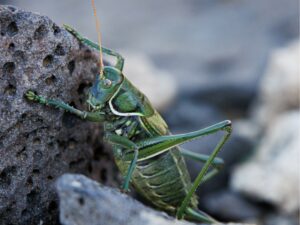
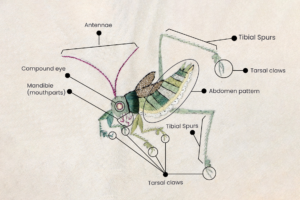
This Chinese silk collar from the early 20th century features a detailed embroidered depiction of a male Gampsocleis gratiosa. The absence of an ovipositor (female reproductive organ) and the distinct pads on the tibial spurs are faithfully captured, along with the shape of the tarsal claws and abdominal patterning. This species appears prominently in Chinese culture due to its association with traditional insect-keeping practices, especially during the Qing and Ming Dynasties; the accuracy of this embroidery could be attributed to this cultural practice.
This insect is commonly called guōguo (蝈蝈) in Chinese, which is an onomatopoeia, imitating the rhythmic sound of the insect’s song. Guōguo captured in the wild or bred in captivity are kept in specialized enclosures for the enjoyment of their song. This textile not only illustrates masterful embroidery but also reflects the significance of this insect in Chinese culture.
5. “Spring” Mini Quilt, Lucile E. Hawks, United States, cotton, 2006.
Donor: Lucile E. Hawks, Avenir Museum no. 2006.181Q
6. Gold Couched Table Runner, China, silk, beads, 20th century.
Donor: Ann Hyde and Fred Birdsall, Avenir Museum no. 2005.26
7. Armchair Cover, China, silk, 20th century.
Donor: Ann Hyde and Fred Birdsall, Avenir Museum no. 2005.29A
8. Lace with Butterflies, United States, cotton, 19th century
Avenir Museum no. 1978.33.92
9. Butterfly Mini Quilt, Lucile E. Hawks, United States, cotton, 2006.
Donor: Lucile E. Hawks, Avenir Museum no. 2006.181M
10. Red Silk Day Ensemble, Adele Simpson, United States, silk, 1960s-early 1970s.
Donor: Barbara Eastwood-Schultheis Avenir Museum no. 2007.54ABC
Moths: Friend or Foe?
When thinking of insects and textiles together, many fashion fans might feel fright. Several species of insects, in particular the case-bearing clothes moth and the webbing clothes moth, eat materials like cotton or wool. These garments came to the Avenir collection with holes eaten by moth larvae.
While clothes moths can be the bane of closets, they are important cleaners in the wild. Their consumption of organic materials speeds up the decomposition process of animal remains, providing a helpful housekeeping service for the environment. It is only in their interactions with humans that clothes moths may be cast as a pest.
11. Bodice with moth damage, United States, wool, 1900.
Donor: Mary Denis Smith, Avenir Museum no. 981.177B
12. Flight Attendant Uniform with moth damage, United Airlines, wool, 1959-1960.
Donor: Linda L. Alexander, Avenir Museum no. 2022.15.2
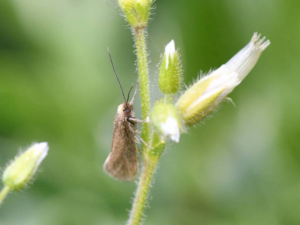
Silk and Sericulture
According to Chinese legend, Leizu, the wife of the Yellow Emperor (c. 2640 BCE), discovered silk when a cocoon fell into a warm cup of tea and unraveled in a long, single thread. Sericulture, or the process of cultivating silkworms and producing silk thread, remained a tightly guarded secret for thousands of years. Outside of China, silk was enveloped in mystery. For example, the Roman historian Pliny the Elder (23-79 CE) believed silk was made from a downy coating on leaves. Following the establishment of the Silk Roads network in the second century BCE, the heightened desire for silk textiles and domestic sericulture industries led to trade and conflicts that brought distinct cultures together, often for the first time.
Silk is a remarkable fiber due to the length—up to half a mile—and strength of a single filament. The pyramidal shape of the filament reflects light and contributes to the high luster, or shine, of silk textiles. To maximize the length of the filament, it is necessary to steam or bake the cocoon to kill the pupa inside before it breaks through as a moth. Ahimsa silk, or peace silk, utilizes an alternative method that allows the pupa to eat through the cocoon, leaving shorter pieces of fiber that are spun together.
Bombyx mori – Domesticated Silkworm*
Family: Bombycidae (Silk Moth)
Domesticated in China over 6,000 years ago, Bombyx mori is one of the oldest known examples of insect domestication by humans.
Through centuries of selective breeding, this species has become completely dependent on humans for survival. Their wings are too underdeveloped to fly, and they lack natural camouflage or defense, making them vulnerable to predators. If the cocoons are not harvested, the adult moths emerge with no ability to eat. Their short adulthood is solely for reproduction, lasting one to two weeks before the cycle begins again.
The silk they produce remains unmatched in quality. Each larva spins a single continuous thread to form its cocoon. When harvested, the cocoons are boiled to extract the intact silk strand, which can stretch hundreds of meters in length.
13. Manchu Woman’s Silk Robe, China, silk, 19th century.
Donor: Sophie Aldrich, Avenir Museum no. 2024.2.1
The Manchu woman’s silk robe dates to the late 19th -early 20th century the body of the robe is woven from bright red silk patterned with a subtle repeating floral medallion.
The black trim around the neckline and perimeter of the robe has been embroidered with flowers and butterflies, the same design is replicated on the lowest part of the sleeve cuff with the flowers and butterflies on a woven white ground. An applique of floral-patterned silk ribbon with gold edging winds around the black embroidered trim drawing attention to the curvilinear neckline, a design typical of Qing dynasty style.
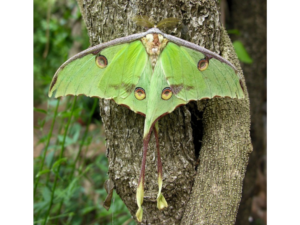
Argema mimosae – African Moon Moth*
Family: Saturniidae (Giant Silk Moth)
This striking moth is native to Africa and belongs to the silk-producing Saturniidae moth family. Argema mimosae is celebrated for its unique cocoon structure and large, ornate wings. These large wings with long trailing tails and eye-like patterns serve as both camouflage and to deter predators.
The Luna Moth (Actias luna) is a close relative to the African moon moth and is native to North America. Both species showcase long tails and ethereal wing coloration, highlighting the elegance found across the Saturniidae family.
14. Swazi Ankle Rattle, Eswatini, Silk Cocoons, 20th century
Donor: Richard Peigler, Avenir Museum no. 2016.38.2
While the domestic silkworm is famous for its textile contributions, the silk of wild moths can also be harvested to make bodily adornments.
The Swazi people of Eswatini (formerly Swaziland) collect the cocoons of the African moon moth to make ankle rattles used in ceremonial dances.1 One end of the cocoon is cut off, and small stones or seeds are inserted for sound. The cocoons are then sewn onto a woven cord worn around the lower leg.2
15. Woman’s Robe, China, silk, Mid-20th century,
Donor: Evie Barnes, Avenir Museum no. 2001.106
Insect and Textile Coloration
Insects display a wide variety of colors. While many insects get their coloration from chemical compounds in their bodies (biological pigments), some insects get their color from a phenomenon known as structural coloration. Unlike pigment-based colors, structural color arises from microscopic structures on the insect’s exoskeleton that interact with light, bending, scattering, and reflecting that incoming light in complex ways, creating vibrant hues.
Because structural color depends on how light reflects and refracts across these microstructures, the perceived color can shift dramatically depending on the viewing angle. This results in vivid metallic sheens, iridescent gradients, or shimmering effects that can seem to change color in motion.
Structural coloration is most famously seen in butterflies and beetles, but it also appears across bees, flies, and other insect groups. Its beauty is more than aesthetic—it often plays a role in camouflage, mating, or warning displays.
Textiles
In the insect world, shimmering color often signals “Avoid me! I taste bad and may be poisonous.” In the human world, shimmering color in clothing often means “Adore me! I am beautiful.”
These garments achieve their glimmer by weaving together two different colors of silk threads. The warp (thread running up and down) uses one color, and the weft (thread running side to side) uses a different color. Because of the natural luster in silk, the two colors running in perpendicular directions create the iridescent effect seen on these garments.

16. Green and Red Bodice, Euro-American, Silk, 1890s.
Avenir Museum no. 2001.197A
17. Purple Skirt and Cape, Euro-American, silk, 1860s-1900s.
Donor: Caroline Ostertag, Avenir Museum no. 1973.3.7AB
18. Green and Purple Taffeta Bodice, Euro-American, silk, 1859.
Donor: The Brooklyn Museum, Avenir Museum no. 1980.23.27
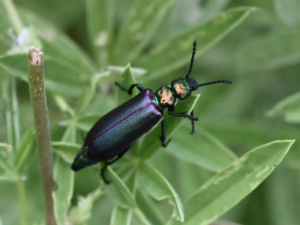
Lytta nuttalli – Nuttal’s Blister Beetle
Family: Meloidae (Blister beetle)
Lytta nuttalli is a striking species of blister beetle, belonging to the family Meloidae. Lytta nuttali is native to Colorado, including Fort Collins. Blister beetles are named for their ability to secrete a potent chemical called cantharidin, which can cause severe blistering, skin irritation, and swelling upon contact. This defensive compound serves as a powerful deterrent against predators.
Lytta nuttalli is relatively large for a blister beetle, and its vivid appearance makes it a standout among its kind. The elytra (hardened forewings) display a mesmerizing gradient of iridescent purple to deep blue, while the thorax and body shimmer with structural colors ranging from green to blue to near black. This brilliant coloration is not just visually striking—it may function as a signal warning predators of the beetle’s chemical defenses.
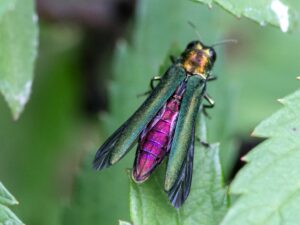
Jewel Beetles
Family: Buprestidae (Jewel beetles/flatheaded borers)
Jewel beetles, belonging to the family Buprestidae, are known for their brilliant, metallic structural coloration with shimmering hues—often green, blue, copper, or gold
While admired for their beauty, many jewel beetle species are also wood-borers. The larvae live inside trees, feeding on the wood, weakening or killing their host tree. One well-known example is the Emerald Ash Borer, an invasive species in North America that has caused widespread damage to ash trees.
Victorian Ornament
In the second half of the nineteenth century, European women’s fashionable dress and accessories increasingly incorporated insects as ornamentation. This trend started in the 1840s when cotton textiles with embroidered beetle motifs were imported to England from India.3 From the sixteenth to eighteenth centuries in India, iridescent beetle wings were used to decorate high-status clothing.4 By the 1860s, European fashions readily incorporated whole insects—both living and deceased. Scarab necklaces, live bejeweled beetles attached to bodices with gold chains, glow-worms or fireflies contained within hairstyles, and a dress decorated with 5000 shimmering beetle wings are recorded examples of insect fashions.
Interest in the natural world flourished in the nineteenth century in response to the rise of modern industrial cities. Natural history museums, zoos, and botanical gardens brought the flora and fauna of expansive colonial empires to the metropole. The fashion for insect-embellished jewelry is part of this effort to “domesticate” the exotic. At the same time, it has been interpreted as a sign of the sentimentality and emotional attachment characteristic of Victorian culture.5
19. Drawing, Design for Necklace with Brazilian Beetles; USA; graphite, brush and watercolor, white heightening on tracing paper; 12.6 x 19.2 cm (4 15/16 x 7 9/16 in.); 1910-44-1
Drawing, Design for Necklace with Brazilian Beetles, ca. 1900; USA; graphite, brush and watercolor, white heightening on tracing paper; 11.2 x 19 cm (4 7/16 x 7 1/2 in.); 1910-44-4
20. Beetle Sweater, Tory Burch, United States, acrylic wool, sequins, beads, 2013. Avenir Museum no. 2026.1.1
This sweater is from the Tory Burch Fall 2013 collection, which utilized insects as the central design motif. According to Burch, this collection was inspired by “art nouveau and Gustav Klimt and the crystal of (Rene) Lalique…That era had a lot of scarabs and dragonflies.”6 The sweater features sequins and beads fashioned into beetles at the neckline, evocative of the necklaces popular during the Victorian insect craze. The desire for insect fashion can be seen in these two necklace designs featuring beetle bodies in place of jewels from 1900.
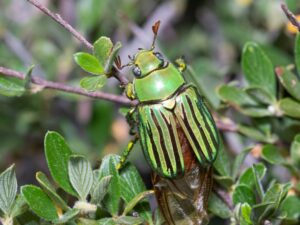
Chrysina gloriosa – Glorious Scarab*
Family: Scarabaeidae (Scarabs)
Commonly known as the Glorious Scarab, Chrysina gloriosa is a jewel-like beetle native to the southwestern United States and parts of northern Mexico. This species is especially known for its dazzling green and silver stripes, a result of structural coloration.
Small Bug, Big Impact
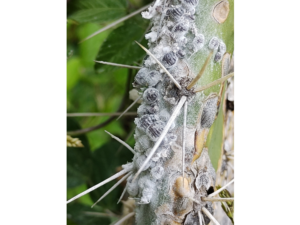
Dactylopius coccus – True Cochineal Bug
Family: Dactylopiidae
Native to South America through the southwestern United States, the true cochineal bug is known for producing an intense red pigment. It feeds on cacti, especially species in the Opuntia genus.
This species shows striking sexual dimorphism. Males are small, have wings, and are capable of flight. Females, by contrast, are wingless, rounded, and largely immobile. Their bodies are coated in a waxy substance that protects them and their offspring from predators and environmental stress.
The vivid red pigment—called carminic acid—is found in the blood of adult females. For the cochineal bug, the carminic acid is a deterrent to being eaten. Carminic acid has been used historically as a natural dye in textiles and continues to be valued for its strong coloration and natural origin.
Colonialism and Cochineal
Following colonial contact, cochineal—alongside sugar, silver, and cotton—was one of the many natural resources extracted from the Americas to fund the growing Spanish empire. In 1464, Pope Paul II officially changed the color of the papacy from purple to red. This cemented an association between red and power that fueled demand for the color. Spanish colonizers responded by shipping hundreds of thousands of pounds of dried cochineal insects across the Pacific to the Philippines and across the Atlantic to Europe, where they were used to dye yarn used in French tapestries, Italian silk velvets, and the red coats of the British army.
According to the historian Gabriela Soto Laveaga, European Franciscan and Dominican monks took credit for teaching Indigenous peoples in Mexico how to cultivate and process cochineal.7 This created a false narrative that Indigenous peoples could not process cochineal without European assistance. However, cochineal was central to Indigenous knowledge. It was used in ceremonies and rituals, to color Aztec codices, and, as early as the second century BCE, to dye textiles.
21. (starting in upper left corner, clockwise)
“Kinsa Yachay Munay Tika (The Three Beautiful Flowers),” Mario Quispe, Santa Cruz de Sallac, Peru, wool, 2010.
Donor: CTTC/Marilyn Murphy, Avenir no. 2013.31.6
Manta (Carrying Cloth), Enriqueta Huaman Quispe, Accha Alta, Peru, alpaca wool, 2011.
Donor: CTTC/Jan Else, Avenir Museum no. 2013.31.11D
Cochineal Diorama, Built by Leo Liu, 2025
Cochineal-dyed yarn, Peru, wool, 2013.
Donor: CTTC/Jan Else, Avenir Museum no. 2013.31.8GHIJK
Men’s Ceremonial Tzute, Chichicastenango, Guatemala, cotton and silk, mid-1920s-1940s.
Donor: Martha Egan, Avenir Museum no. 2012.56
22. (starting in upper left corner, clockwise)
Insect Specimen Drawer, on loan from the C.P. Gillette Museum of Arthropod Diversity
Beetles With Structural Color:
1. Jewel Scarab
2. Rainbow Scarab
3. Nuttall’s Blister Beetle
4. Jewel Beetles
Textile Pest:
5. Clothes Moth
Silk Producing Insects:
6. Web Spinners
Unnumbered. Cecropia Moth
7. Luna Moth
Partially Unwound Silk Thread, Unwound and set by Leo Liu, 2025
Silk Moth Diorama, Built by Leo Liu, 2025
References
[3] Michelle Tolini, “‘Beetle Abominations’ and Birds on Bonnets: Zoological Fantasy in Late-Nineteenth Century Dress,” Nineteenth-Century Art Worldwide 1, no. 1 (2002): 137.
[4] “Dress,” Victoria and Albert Museum, https://collections.vam.ac.uk/item/O1387342/dress/.
[5] Julia Long, “Portable Pets: Live and Apparently Live Animals in Fashion, 1880-1925,” Costume 43, no. 1 (2009): 109.