


Introduction
The knot of a scarf, the stripes on a jersey, the cut of a pair of bell bottoms—these are just a few of the many enduring signs that say “sailor.” The sailor look has been a recurrent style in American fashion for three centuries. In revolutionary-era Philadelphia, dozens of young apprentices and servants could be distinguished by their short readymade sailor jackets. In the pre-Civil War period, the sailor was an iconic figure in Northern advertising and propaganda. By the twentieth century, womenswear adapted the sailor look to outfits associated with sports, physical exercise, and social liberation.
Focusing on this last period, Anchors Aweigh uses eleven ensembles from the Avenir Museum to show how the sailor look moved from masthead to main street. While drawing on an established repertoire of collars, kerchiefs, and decorative stripes, the garments illustrate how each decade produced its own iteration of sailor style. Additionally, numerous images from the eighteenth through the twentieth century situate these garments within the broader history of nautical fashion. Finally, as some of the garments suggest, the evolution of sailor dress was not only led by the whims of designers but may also have reflected the shifting priorities of their female wearers.
Through its pieces, Anchors Aweigh explores three major themes in the history of sailor style. These are: (1) the presence of alterations, repairs and other make-do’s during the first decades of the twentieth century, (2) the role of sailor fashions within the boom in fashionable, ready-to-wear women’s clothing of the mid-century, and (3) the presence of parody, pastiche, and self-reference in the sailor look of the late twentieth century. Though carefree in its connotations, there is nothing either accidental or ephemeral about sailor dress.
Objects
1. Two-Piece Suit. 1910s (Lining c. 1930s). Silk Taffeta. Avenir Museum. 2000.236. A, B.
During the 1910s, partly in response to the austerities of World War I, womenswear grew more streamlined and less restrained. In the process, it often drew inspiration from military uniforms. This blue silk taffeta suit, for example, incorporates elements of naval dress: The square collar, with its embroidered thread border, evokes the designs seen on sailor’s blouses. Meanwhile, the false slash cuff mimics the so-called “mariner’s cuff” on naval dress uniforms. This process of adaptation is even visible in the construction of the garment: At some point during the jacket’s life, possibly during the 1930s, it was re-lined with a semi-synthetic fabric.
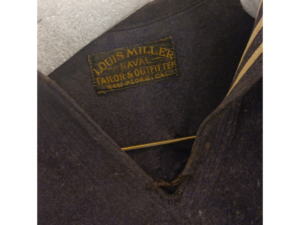
2. Louis Miller, Naval Outfitter. Blue Winter Sailor’s Blouse. 1921. American, San Diego. Wool. Avenir Museum. 90.28.1
Featuring a warrant officer’s insignia on the left sleeve, this blue wool sailor’s blouse appears to be a standard piece of uniform kit. However, the label on the inside collar indicates that it was privately purchased from Louis Miller, a specialist tailor in San Pedro, California during the 1910s and 20s. 1 Naval tailors like Miller were common during this period and their advertisements, offering bespoke versions of naval uniforms, filled periodicals targeted at enlisted sailors. While conforming to official orders, custom fitting let sailors put their personal imprint on regulation dress.
3. Gym Ensemble. 1920s. American. Cotton and Wool. Avenir Museum. 2010.163. A, B.
At the turn of the twentieth century, middle and upper-class women and girls adapted nautical styles for exercise wear.2 The blouse or, “middy,” was based on the loose naval pullover and features a square sailor collar. The bloomers originated with the loose pantaloons worn by mid-nineteenth century women’s dress reformers as an alternative to restrictive corsets and crinolines. Later, bloomers became a feature of women’s bathing and cycling costumes in the 1890s.3 Unlike the white middy top, which could easily have been bought readymade, these bloomers feature several repairs and alterations and might have been sewn at home.
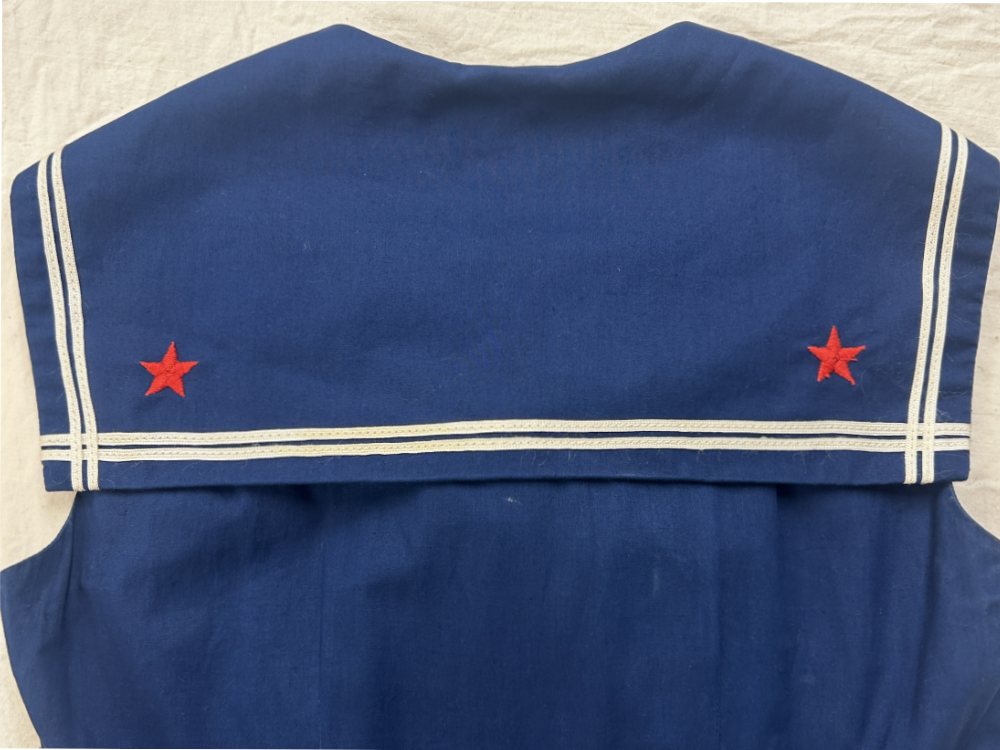
4. Henry Rosenfeld. Blue Sailor Dress. Late 1940s. American. Cotton or Linen. Avenir Museum. 86.16.4.
This blue cotton dress was manufactured by New York-based dressmaker Henry Rosenfeld. It is made of a lightweight blue cotton and features a middy collar with white stripes and red embroidered stars. The zipper fastening at the side of the dress is a relatively new-fangled means of improving the garment’s fit. Likening himself to Henry Ford, Rosenfeld excelled at producing cheap, readymade dresses like this one for a national market. His clients included the United States Navy and Marine Corps, whose uniforms may have inspired some of the trimmings on this dress, specifically.
5. Nassau Fashions. Navy Blue Jacket and Skirt. 1940s. American. Cotton. Avenir Museum. 85.35.1.
During the 1930s and 40s, women’s clothing—including sportswear– became more structured and closely tailored. This blue cotton jacket and skirt, designed by Floridian Margaret Miller, utilizes both tailoring techniques and design features derived from nautical dress. The collar, for instance, combines a square-cut, sailor-style yoke with a notched-lapel, typical of contemporary menswear. The shoulders are padded. The skirt, likewise, incorporates features from men’s suits, including gores and darts to improve fit, and is fastened with a zipper. Through her label, Nassau Fashions, Miller specialized in similar examples of leisurewear.
6. United States Navy. Summer Blouse and Trousers. 1940s. American. Cotton. Avenir Museum. 91.295 A, B.
Consisting of a blouse and trousers made of hard-wearing cotton twill—like on modern jeans– this white naval uniform is a typical example of “undress.” Unlike the dress blues (object 10), which featured a blue collar and cuffs, this blouse in unadorned. The trousers for the white uniform also feature a conventional button-fly front, instead of the distinctive fall-front seen on the winter uniform. Contemporary regulations specified that these less-decorated uniforms were to be worn on ordinary occasions, during the summer months.4
7. Laura Ashley, Blue Day Dress. Early 1990s. American or British. Corduroy. Avenir Museum. 2001.20.
Beginning in the 1950s, British designer Laura Ashley drew on historic dress and textiles to create dresses that brought the Victorian countryside into modern wardrobes.5 Though manufactured after Ashley’s death, this dress shows the continuing influence of her nostalgic vision. The ubiquitous middy collar recurs, while the two-button cuff flap is seen throughout naval uniforms and nautically-inspired dress, such as Object 2. Worn by the donor for her engagement photographs, this dress indicates the continued versatility of the sailor look in accommodating new fashions at the end of the twentieth century.
8. Sport Ensemble. 1970s. Polyester. Avenir Museum. 94.138 A, B.
Developed during World War II, cheap and color-fast polyester became an ubiquitous fabric during the second half of the twentieth century.6 The blouse of this polyester ensemble is an evolution of the “middy” style seen on earlier exercise wear, such as Object 3. It features short sleeves, a buttoned front, and red kerchief. During the mid 1970s, “hot pants,” as seen on this ensemble, emerged as an economical alternative to the voluminous midi dresses popular early in the decade. During this period of economic recession, women could either make their own pairs or alter existing dresses into these abbreviated garments.7
This ensemble is paired with a paper pattern by Simplicity (c. 1972) for a similar design and other sailor-style garments. This shows how the demand for sailor-style fashions was fulfilled by both mass-production and home-sewing.
9. Momentos (Nancy Johnson). Naval Themed Day Dress. 1980s. American (Fabric manufactured in India). Cotton. Avenir Museum. 2022.9.10.
Designer Nancy Johnson specialized in daywear which balanced formality with femininity. The byline for Johnson’s 1988 collections billed her as “The Woman with a Past,” and in interviews, Johnson expressed affection for “the myth,” of historic garments.8 Johnson’s ensemble playfully blends references to historic naval uniforms, such as the square collar and imitation-brass anchor buttons, with red-white-and-blue bicentennial kitsch. The Indian cotton textile used for the dress also had historic significance: Manufactured using a special handloom, the fabrics, according to Johnson, “[embodied] a social phenomena counter to the machine age.”
10. US Navy. Blue Wool Blouse and Trousers. C. 1941-45. American. Wool. Avenir Museum. 94.1 A, B.
Along with the white “dixie cup hat” and knotted kerchief, this jumper and trousers represent a standard set of enlisted dress blues of the Second World War and beyond. The trousers feature the characteristic fall-front fastening derived from eighteenth-century civilian men’s breeches. Over the course of the nineteenth century, the fall became an iconic feature of naval dress. The Navy’s attempt to replace it with a more modern fly opening following the War led to protests and the eventual withdrawal of the order.9 The yellow insignia on the right breast of the blouse indicates an honorable discharge.
11. Chanel Boutique. Knit Top, c. 1985. French. Cotton, Polyester, and Nylon. Avenir Museum. 2013.24.022.
Dolce and Gabbana, Wide Leg Sailor Pants, c.2000. Italian. Cotton Twill.
Hermès. Scarf. French. Silk. Avenir Museum. 2020.14.15.
This pair of blue, twill-woven cotton pants incorporates many features of historic naval dress. The cut of the pants recalls the wide-legged “slops” worn by sailors during the eighteenth century, (Object 13) while the button trimming on the outside leg is a style seen on eighteenth-century men’s riding overalls. The pants feature a nautical fall front trimmed with black plastic anchor buttons, reminiscent of twentieth-century naval dress uniforms (Object 10). These historic features combine to produce a loose silhouette evocative of contemporary streetwear, illustrating how designers regularly return to historic prototypes to create their most up-to-date fashions.
Images (wall opposite glass case)
12. “The British Hercules,” British, c. 1737. Print. 273 mm x 187 mm. British Museum, 1868,0808.3590. © The Trustees of the British Museum. Shared under a Creative Commons Attribution-NonCommercial-ShareAlike 4.0 International (CC BY-NC-SA 4.0) licence. [British Museum—Available for display in a public place under Creative Commons License]
13. John Singleton Copley, “Watson and the Shark.” American, 1778. Oil Painting. National Gallery of Art. [Available to reproduce free of charge, under Creative Commons License 0, from the National Gallery]
During the eighteenth century, sailors were issued readymade jackets, shirts, and trousers from their ship’s stores. Sailors in contemporary art were often shown wearing a distinct style of wide-legged trousers, known as “slops” or “petticoat breeches.” American painter John Singleton Copley, for instance, depicted a sailor dressed in slops and short blue jacket in his heroic canvas “Watson and the Shark.” Later, the term slops came to refer to all readymade clothing, and their dealers, known as slops sellers, were fixture of the urban clothing market. Eighteenth and nineteenth-century slops sellers influenced popular fashions on both sides of the Atlantic.10
14. William Alexander. “Sailor,” British, 1814. Print. New York Public Library. [NYPL– No known copyright restrictions, public domain]
15. James Green, “Mary Anne Talbot otherwise John Taylor,” British, c. 1804. Print. 205 mm x 125 mm. British Museum. © The Trustees of the British Museum. Shared under a Creative Commons Attribution-NonCommercial-ShareAlike 4.0 International (CC BY-NC-SA 4.0) licence. [British Museum—Available for display in a public place under Creative Commons License]
16. George Jacques Gastine, after Paul Garvani. “Marinière,” French, c. 1830. Print. 291 mm x 195 mm. British Museum. 1874,1114.1101. © The Trustees of the British Museum. Shared under a Creative Commons Attribution-NonCommercial-ShareAlike 4.0 International (CC BY-NC-SA 4.0) licence. [British Museum—Available for display in a public place under Creative Commons License]
Women had a long history serving aboard naval vessels disguised as men. Hannah Snell served in the British Marines during the 1730s, while in the Napoleonic Wars, Mary Anne Talbot disguised herself as a sailor (image 15). This French print from the 1830s, from a series titled “Travestissemens,” plays on this theme of disguise: It depicts a woman in an outfit that combines various features of naval dress, including a hat that resembles a life preserver, in a deliberately incongruous manner. According to some authors, these masculine-coded items emphasized the wearers’ femininity.11 It was through such theatrical disguises that naval dress first entered women’s fashion.
17. L.V. Newell, “Seaman Alfred Bailey,” American, c. 1864-1865. Photograph. Library of Congress. [LOC—no known restrictions on publication]
18. Nathaniel Currier, “The Young Sailor.” American, 1849. Lithograph. Brown University Library. [Public Domain]
By the mid-nineteenth century, sailor’s dress had evolved into the recognizable combination of square-collared jumper and bell-bottom trousers. At the same time, the sailor suit, with its connotations of adventure and activity, became a fixture of middle- and upper-class children’s wear. This mid-nineteenth century print, based on an earlier painting of the future King Edward VII of Great Britain, shows an early example. While the material and decoration of commercially-available outfits varied widely from this model, they retained its distinctive collar and trimming.12 By the early twentieth century, sailor-style garments became increasingly prevalent in adult women’s wear.
19. Lorenzo Hatch, “Woman in White.” American, 1906. Oil Painting. Bennington Museum, 1989.62. 78”X38”.
20. Frank R. Snyder, “Western College Basketball Juniors.” American, 1912. Photograph. Miami University Libraries. [Wikimedia Commons—Public Domain, published before 1930]
21. Paul Cadmus, “The Fleet’s In!” American, 1934. Oil Painting. Naval History and Heritage Command. [US Naval Property—Public Domain]
Since the eighteenth century, the sailor had been an archetype of nationalism and masculinity. At the same time, the homosocial society aboard ship made the sailor sexually ambiguous Twentieth-century painter Paul Cadmus drew on both connotations in his 1934 painting, The Fleet’s In. Cadmus exaggerated the shore-going sailors’ muscular physiques, while also showing them engaged in queer activities: On the far left, a marine accepts a cigarette from a blond figure conforming to early twentieth-century stereotypes of an effeminate gay man. Though initially censored by the navy for its controversial subject matter, the painting was later recognized as landmark work of twentieth-century queer art.
22. Hayden Hayden, Naval Recruitment Poster. American, 1943. Print. Library of Congress. [LOC—no known restrictions on publication]
References
[1] See, for instance, Advertisement, San Pedro News Pilot November 11, 1921.
[2] Amber Butchart, Nautical Chic (Thames and Hudson, 2015), 56.
[3] Gayle V. Fischer, Pantaloons and Power: A Nineteenth-century Dress Reform in the United States (Kent State
University Press, 2001), 171.
[4] United States Navy, Uniform Regulations, 17-18.
[5] Anne Sebba, Laura Ashley: A Life by Design (Weidenfeld and Nicholson, 1990), 32, 85.
[6] Michiel Scheffer, “Synthetics,” in Berg Encyclopedia of World Dress and Fashion, Volume 8: Western Europe, ed.
Lise Skov (Berg, 2010), 96-97. http://dx.doi.org/10.2752/BEWDF/EDch8020.
[7] Oline Eaton, “The Great Leg Show!” Contingent Magazine, January 29, 2024,
https://contingentmagazine.org/2024/01/29/the-great-leg-show/.
[8] Maureen Sajbel, “Nancy Johnson: Lessons from the Past,” Women’s Wear Daily, October, 1987.
[9] Robert H. Rankin, Uniforms of the Sea Services: A Pictorial History (Annapolis: United States Naval Institute,
1962), 110-111,
[10] Tyler Rudd Putman, “Joseph Long’s Slops: Ready-Made Clothing in Early America,” Winterthur Portfolio 49, no.
2/3 (Summer/Autumn 2015): 63-91.
[11] Nadine Wills, “Women in Uniform: Costume and the ‘Unruly Woman’ in the 1930s Hollywood Musical,”
Continuum 14, no. 3 (2000): 318.
[12] Claire Rose, “What Was Uniform about the Fin-de-Siècle Sailor Suit?” Journal of Design History 24, No. 2
(2011): 108-110.