


Acknowledgements
Curator:
Vidhita Raina, PhD
Linda L. Carlson University Chair, Avenir Museum
Curatorial Assistant:
Latifah Hirchi-Vogl
Kimono Dressing:
Masako “Mako” Beecken
This exhibition is the result of the collective dedication, creativity and care of the Avenir Museum team including staff, students, interns, and volunteers. From research to preparation, installation, and visitor experience, their shared efforts bring these stories to life.
With gratitude to the Avenir Foundation.
Introduction
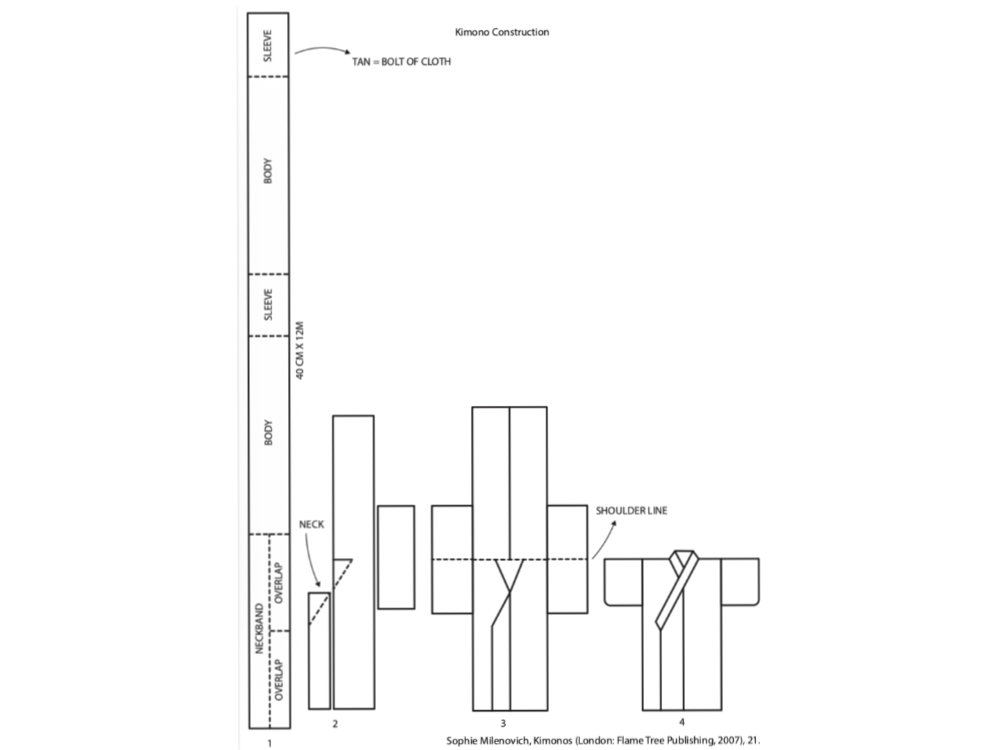
This exhibition addresses why studying the kimono still matters today, and how the matter and materiality of kimonos have shaped their place in history. The kimono 着物, an iconic sartorial symbol of Japan worn across genders and ages, is an abbreviation of kirumono, simply meaning “a thing to wear.” With a minimal straight-edged construction, kimonos have been integral to the long history of Japan, often acting as modern, political, cultural, and social objects. In contrast, outside of Japan, the kimono transformed into an enigmatic and feminized garment.
In 1639, Japan was placed under a political isolationist policy (sakoku). With the “Arrival of the Black Ships” (kurofune raikō) in 1853, a gunboat diplomatic1 expedition led by American Commodore Matthew Perry, Japan was threatened into ending its 220 years of isolation. With the “opening” of Japan’s trade doors, kimonos, among several other art objects like lacquerware, ceramics, and woodblock prints, flooded Western markets. In this context, kimonos were viewed as exotic, traditional clothing, shrouded in fantasy.2 Recent scholarship has steadfastly challenged this past view, underlining how the kimono robustly fashioned both Japanese and global cultures in a multitude of ways. Kimono Matters expands on this decentering perspective and emphasizes the intertwining roles of textile design and craft production in kimono fashion history.
Highlighting six textile techniques– tie-dyeing (shibori), ikat (kasuri), meisen silk, resist-dyeing (yūzen), brocade (nishiki), and stencil resist-dyeing– this exhibition asserts the importance of the textile methods, dyes, and designs that fashioned the modern kimono. This exhibition draws from the Maxson Kimono Collection at the Avenir Museum of Design and Merchandising which was donated by Mary Louise Maxson in 1993. Last exhibited 32 years ago, Kimono Matters revisits this collection with a new perspective.
Note
Many of the kimonos in the Avenir Museum collection have no known maker. Historically, the majority of craft and textile production processes in Japan were carried out by anonymous professional makers and artisans. Production was centered around craft guilds or family workshops that exist even today; however, some individual master craftspeople are now recognized as Living National Treasure for their work in preserving intangible cultural practices.
Shibori 絞り
Shibori is a popular resist-dyeing technique which also refers to the fabric it produces. Although it is most commonly associated with tie-dyeing, there are various resist techniques that can be used to create shibori, such as folding and clamping (itajime shibori), binding (kanoko shibori) or stitching (Nuishime shibori). The process of creating shibori includes securing sections of the textile by any of these methods which protect the tied-off sections when the cloth is submerged in a dye vat. Japanese artisans are known for mixing and merging different textile techniques and shibori is often combined with embroidery.3
1. Kimono, 1900s
Fawn-spot tie-dye (kanoko shibori) on silk
Taishō period (1912–1926)
2005.261
Indigo dyeing (aizome) has been and continues to be a popular method for shibori. Some of the earliest surviving examples of resist-dyed cloth in Japan date to the eighth century, although shibori gained widespread popularity only during the Edo period (1615–1868) when regions like Kyoto, Narumi, and Arimatsu became known for their exceptional shibori production, a reputation that continues to this day.4 The meticulously executed small dots of this kimono were pinched, bound, and dyed and allude to fawn-spots, thus lending itself to the poetic name of the technique, kanoko shibori.
Kasuri 絣
Kasuri is a form of resist-dyeing technique recognized globally as ikat (a Malay term). In this process, sections of the warp (vertical threads), weft (horizontal threads), or both threads are tightly bound in a pre-determined pattern, before being immersed into a dye vat. The bound yarns are protected from the dye. The dyed threads are subsequently woven with the pattern conceived of and executed prior to dyeing.5 In short, the threads are resist-dyed to produce patterns that only appear after being woven into cloth. The Japanese term kasuri comes from the expression for the resulting blurry design, known as kasureta.
2. Yukata (summer kimono), 1900s
Cotton and bast fiber, Ryukyu kasuri
Taishō period (1912–1926)
2005.143
This summer yukata is an exquisite example of Ryukyu kasuri. The Ryukyu Kingdom (1479–1879) was an active maritime state that ruled over much of the southernmost Ryukyu Islands (present-day Okinawa). Ryukyu kasuri follows the same methodology as kasuri and is one of the sakizome (yarn-dyed) processes. First, the pattern is designed for the cloth. Oftentimes these designs are derived from the historic pattern book Mizuecho which consists of around 600 designs. These patterns stem from nature such as animal and plant motifs. Another distinctive feature of Ryukyu kasuri is the use of a ruler, to mark sections of the yarn to be bound with mathematical precision. As visible in this kimono, abstract Okinawan patterns include those of birds (tuiguwa), diagonal crosses (hikisagi), and diagonal blocks that are colloquially called “fussy eyebrows” (mayubichi). The local ecology of Okinawa has shaped the materials used to make Ryukyu kasuri, such as plant dyes like Ryukyu indigo (Ee), garcinia subelliptica (Fukugi or “happiness tree”), and yeddo hawthorn (Tekachi).6
Obi (waist-sash)
2010.312
The obi is tied meticulously around the waist to hold the kimono in place. The elegant blue cord (obijime) in turn is tied to secure the obi.
Kimono dressed by Masako “Mako” Beecken.
Meisen 銘仙
At the turn of the twentieth century, a new technology made silk kimonos economically accessible to a wider range of consumers. First developed in 1909 by Shiraiishi Kai (years unknown) in Isesaki (present-day Gunma Prefecture), meisen was a result of an innovative technique of reformulating the already existing kasuri practice by adopting the hogushiori, “unravel and weave” dyeing method. Now, instead of binding the threads as done in kasuri, a chemical dye paste was painted onto the warp threads through a stencil with a spatula. The warp threads would be held together by temporary weft that were “unraveled” and replaced with new weft threads. Repeat or continuous patterns could be easily created by moving the stencil across different sections. This process increasingly accelerated the time it took to produce resist-dyed cloth that achieved the distinctive hazy and blurry patterns similar to kasuri.7
3. Kimono, 1900s
Silk woven with stencil-printed warp threads (meisen)
Showa period (1926–1989)
2005.176
From the 1920s to the 1950s, meisen silk was used for constructing everyday-wear kimonos. Meisen was relatively inexpensive, which was especially desirable during this period of wartime restrictions on textile production and consumption. It was also deemed attractive due to its bold, often vibrant, and dynamic patterns that were inspired by Western aesthetics, particularly the Art Deco design movement. The dark red and bright blue color pairing of this kimono are used to create a rippling effect, echoing an abstracted wave.
Stencil Resist-Dyeing
Japan has several types of stencil resist-dyeing techniques, the most recognizable being katazome 型染め (literally “stencil dyeing”). The stencils (katagami) are made using the mulberry paper and coated with persimmon juice for durability and waterproofing.8 Katazome gained popularity during the eighteenth century when indigo-dyed cotton was widespread. Subsequently, stencil-dyeing methods evolved during the twentieth century to integrate large-scale stencils that could produce sweeping patterns on kimonos.
4. Hitoe (summer kimono), early 20th century
Ro (gauze weave) silk, stencil resist-dyed
Taishō period (1912–1926) or Showa period (1926–1989)
2005.77
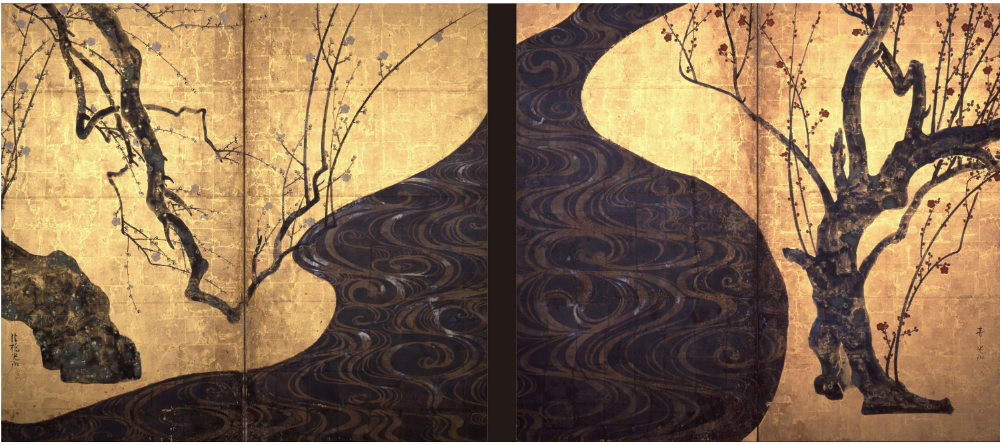
This sheer kimono would be suitable for the humid summer of Japan. Hitoe are unlined, light summer garments oftentimes made of silk, in this case, ro or gauze silk.9 The textural quality of ro provides a lightness to the garment, and the bold swirling pattern was created using a large stencil repeated all over the kimono. This curvilinear wave pattern is inspired by the art of famous eighteenth-century artist Ogata Kōrin (1658–1716) (Fig. 1) who pioneered the Japanese Rinpa 琳派 painting style. It is also viewed as a fusion of Japanese and European aesthetics as the Kōrin wave pattern had in turn inspired motifs of the Art Nouveau movement. Kōrin’s art and aesthetic left an everlasting impact on Japanese textile design. In 1916, Japan’s oldest department store, Mitsukoshi, held an exhibition and a design contest with the theme of “Kōrin-style motifs” to commemorate Kōrin’s 200th death anniversary, which ultimately led to a revival of his artistic style.11
Obi (waist-sash)
2010.313
Kimono dressed by Masako “Mako” Beecken.
Nishiki 錦
Sumptuous polychrome, pattern-woven textiles are called nishiki in Japan. Nishiki is generally translated as “brocade” and refers to textiles woven with supplementary weft designs using dyed and glossed silk and gold or silver metallic threads.12 While the silk ground can be plain, twill, or satin weave, there are two distinct types of nishiki: tate-nishiki 経錦 (when a warp of varied colored threads is interlaced with a weft of one color for each row), and yoko-nishiki 緯錦 (when multicolored weft threads are woven with a single-colored warp). The earliest written reference to nishiki come from Japanese historical accounts like “The Chronicles of Japan” (Nihon Shoki) wherein Nishiki described a clan of artisans.13 Every autumn for its Annual Exhibition, one can likely view the earliest surviving nishiki fragments from the eighth century at the ancient Shōsō-in Repository on the grounds of the renowned Buddhist temple, Tōdai-ji, in Nara.14 Highly prized and luxurious, nishiki continue to be produced in the historic Nishijin textile district in Kyoto.
5. Uchikake (wedding outer-kimono), early 20th century
Brocade silk (Nishiki)
Taishō period (1912–1926)
Donated by Dona Hildebrand
1997.1
This exquisite early twentieth century wedding kimono is constructed of white silk and silver nishiki brocade that ingeniously portray flying cranes all over the main body. Hidden underneath is a bright red lining, which is intended to ward off evil spirits. Folding fans, all embroidered and outlined in bright colors are illuminated with gold accents on tightly woven silk damask. Each fan carries a different seasonal design, including bamboo, pine, chrysanthemums, orchid, and plum. While this kimono has brightly patterned motifs on a white ground, all-white outer-kimonos are also worn by brides, alluding to the pureness of the bride.15 The bride would customarily wear a white inner-kimono, and an outer-kimono (uchikake) that is heavily padded at the hem to enhance the drape of the garment.16 After the wedding ceremony, the bride would change from this white outer-kimono into a vivid one for the reception (see Object 6, on the left). In contemporary times, brides often change a third time, wearing a Western-style dress towards the end of reception.
Yūzen-zome 友禅染
Yet another form of resist-dyeing in Japan is yūzen-zome or yūzen dyeing. The dye technique is named after Miyazaki Yūzen (1654–1736), a famous artist-monk renowned for his fan paintings. Yūzen dyeing is widely credited for establishing a “new pictorialism” in kimono decoration during the Edo period.17 In yūzen dyeing, rice paste (most commonly) is delicately applied on the cloth. The thin outlines of the paste act as a resist, and within its contours dye colors were brushed on. In this way, yūzen was a fluid and adaptable approach to dyeing that allowed artist-dyers to hand-paint their designs directly onto the cloth. Japanese art and textile historian, Kirihata Ken, has best described the four main steps of yūzen dyeing as follows:
“The process begins when outlines of a design are drawn on the fabric. Using a cloth tube fitted with a metal tip, a fine ribbon of starch paste is then applied to this drawing. After the paste has dried, dyes of various colors are brushed within the starch boundaries, which prevent the bleeding of one color into another. The paste is then washed away, leaving fine white lines between components of the design.”18
6. Furisode (long-sleeved kimono), 1900s
Silk, yūzen dyeing
Taishō period (1912–1926)
2005.361
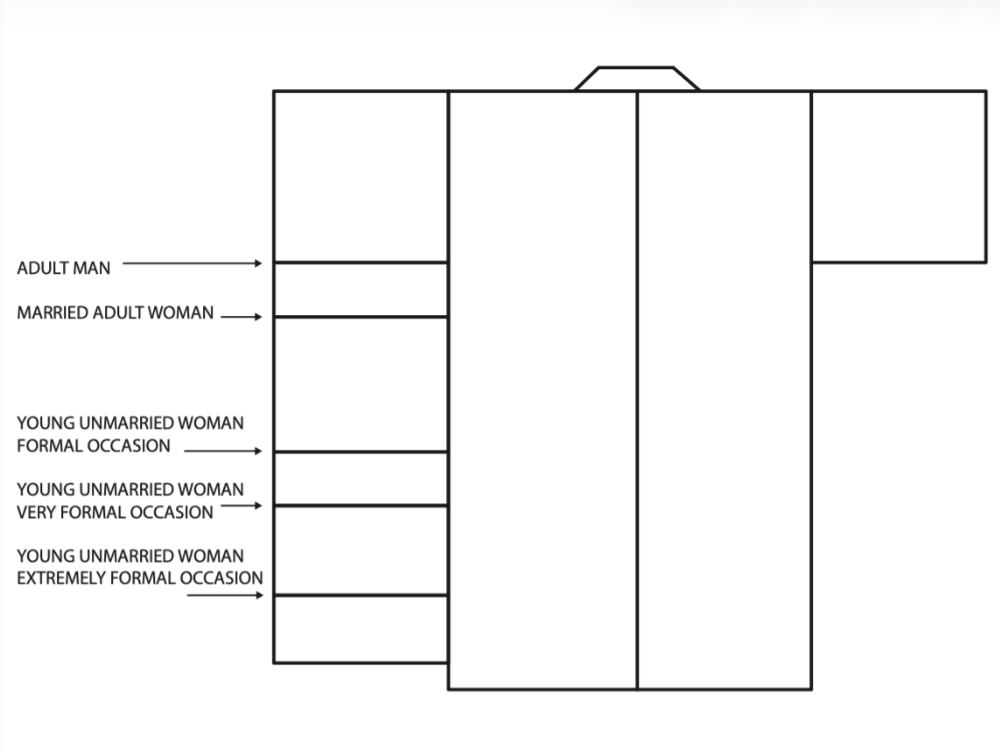
This exquisitely hand-painted silk kimono portrays idyllic pastoral scenes of cranes and ducks, birds that symbolize longevity and harmony in East Asian culture. Three family crests (mon) are subtly integrated into the pattern, emphasizing its ceremonial significance. This kimono is categorized as a formal furisode, largely worn by young, unmarried women, and is distinguished by its long, fluttering sleeves that would sway as the wearer walked.19 With the development of yūzen dyeing, luxurious silk kimonos became the background upon which complex landscapes could be painted on.20
Obi (waist-sash)
Brocade silk (Nishiki)
On loan from Masako “Mako” Beecken
Kimono dressed by Masako “Mako” Beecken.
7. Furisode (long-sleeved kimono), 1900s
Silk, yūzen dyeing and embroidery
Taishō period (1912–1926)
2005.233
As the rice paste outlines are washed away to reveal the painted image, thin white lines left behind by the paste are revealed. Looking closely at this kimono, the white lines of the yūzen dyeing technique are visible.
8. Kuro-tomesode (black ceremonial kimono), mid-20th century
Silk, yūzen-dyed, stencil, hand-painting, and embroidery
Showa period (1926–1989)
2005.101
This black kimono is the most formal kimono worn primarily by married women. As opposed to many of the kimonos you have seen so far, the kuro-tomesode is distinguished by its black color and the designs are placed below the waist, mostly at the hem of the kimono. This kimono exemplifies the Japanese ingenuity to combine textile techniques, from yūzen and stencil-dyeing to hand painting, and embroidery.
Obi (waist-sash)
Nishiki
83.7.14
Obijime (obi chord), mid-20th century
2010.96B
Kimono dressed by Masako “Mako” Beecken.
Pictures of the Floating World (Ukiyo-e)
Woodblock print artists have often depicted things as they saw them, frequently mixing pictorial fiction with reality.21 Even though woodblock prints do not always depict kimonos accurately, they supplement our understanding of kimono design, function, and making. Woodblock prints known as ukiyo-e (“pictures of the floating world”), reached their cultural peak during the eighteenth and nineteenth centuries (such as Katsushika Hokusai’s The Great Wave off Kanagawa, ca. 1830–32). Prints often documented prevailing fashion styles and showcased the fashion influencers of the time, especially the courtesans and kabuki actors who actively participated in fashioning the cultural world of Edo (present-day Tokyo).22
9. Utagawa Hiroshige (1779-1858, Japanese)
Odenma-cho momendana [Cotton Shop in Odenma District]
1858
Color woodcut on paper with mica dust
Gregory Allicar Museum of Art, CSU, gift of George and Alice Drake, 1989.1.40
The bustling city of Edo was a center of trade, commerce, and in turn fashion and textile production. This print from 1858 depicts the Odenma district of Edo where cotton shops (momendana) lined the road. Behind the two courtesans, an inside view of a cotton shop is revealed– two merchants sit amongst tall piles of cotton fabrics, perhaps closing shop at the end of the day. The artist Hiroshige often designed dramatic landscape prints, and this print belongs to the series “One Hundred Famous Views of Edo” (Meisho Edo hyakkei). Cotton is not indigenous to Japan, however, during the eighteenth century, local cotton production increased drastically, especially with the rising fashion for kasuri (ikat) kimonos.
10. Kitagawa Utamaro (1753–1806, Japanese)
Young man shaving neck of courtesan
Circa 1797
Color woodcut on paper
Gregory Allicar Museum of Art, CSU, gift of George and Alice Drake, 1989.1.3
In this woodblock print set in the Yoshiwara district, Kitagawa Utamaro depicts a young man carefully shaving the neck of a courtesan. The licensed district of Yoshiwara was construed in popular imagination as a site of pleasure and entertainment, although the lives of courtesans were far from this. Nonetheless, courtesans were regarded as fashion trendsetters of their times, often leading print artists to portray them wearing the latest kimono fashions, such as the kasuri kimono depicted in this print.
11. Utagawa Hiroshige and Utagawa Toyokuni III / Kunisada I (Japanese)
Ishiyakushi: The Spring View of Takaozan-Mountain from the series Sohitsu gojusan tsugi [The Fifty-Three Stations by Two Brushes]
1885
Color woodcut on paper
Gregory Allicar Museum of Art, CSU, gift of George and Alice Drake, 1989.1.41
The classical Japanese dance-drama known as kabuki developed during the Edo period and was a popular form of entertainment. The kabuki theater, concurrent to the Yoshiwara, was seen as the second heart of Edo and kabuki actors were idolized not only for their performances, but for their fashions and the styles they wore on stage. The color masubana-iro, a light blue-green color, was keenly coupled with the lineage of Ichikawa Danjurō actors. In this print, the actor Ichikawa Omezo is portrayed in all the material splendor of the kabuki theater.
12. TEISAI after Hokuba (1770-1844, Japanese)
Oiran to Kamuro [Courtesan and Apprentice]
Early 20th Century
Color woodcut on paper
Gregory Allicar Museum of Art, CSU, gift of Editha Todd Leonard, 1983.1.58
13. After Utagawa Toyokuni I (1769–1825, Japanese)
Group of Three Courtesans
Early 20th century
Color woodcut on paper
Gregory Allicar Museum of Art, CSU, gift of George and Alice Drake, 1989.1.16
Huddled together wearing splendid kimonos are three courtesans along with their two apprentices. Look closely and you can catch the hints of red under the many layers of the three courtesans’ kimonos. During the Edo period, kimono dyed in red from safflower (beni) was not to be overtly displayed in public. Instead, a beni-dyed under-robe exemplified the quiet and “hidden glamor” of the prevalent iki aesthetics (translated as “chic”). Iki was not simply a fashion statement but also a personal attitude implying elegance and sophistication. Muted color tones such as grays, browns, and blues, as seen in this print, were preferred for outer-kimonos, all while under-kimonos were dyed with the expensive beni-red.23
14. Bijutsukai 美術海, volumes 2 and 3
Woodblock printed books
Meiji period (1868–1912)
Donated by Carolyn Shaver
The Avenir Museum recently acquired these two volumes of the periodical called Bijutsukai that reveal innovative textile and kimono designs prevalent during the Meiji period. Printed from 1896–1911, a total of 65 volumes were published. The Bijutsukai volumes are built upon a long history of pattern books in Japan (known as hinagata bon) the earliest of which were printed in 1666.24 Printed pattern books remind us of the interconnected worlds of textile designers, manufacturers, artisans practicing centuries-old crafts, and kimono makers that continue to shape the future of Japanese fashion.
15. Obi (waist-sash)
Brocade silk (Nishiki)
971.3
16. Obi (waist-sash)
Cotton, katazome
2005.430
17. Obi (waist-sash) fragment
Silk, shibori
2026.28.19
Japanese Historical Periods
Edo period 1615–1868
Meiji period 1868–1912
Taishō period 1912–1926
Showa period 1926–1989
Glossary of Japanese Terms
aizome 藍染め indigo dyeing
beni 紅 red dye from safflower
furisode 振り袖 long-sleeved kimono
haori 羽織 kimono jacket
hikisagi diagonal crosses in Ryukyu kasuri
hinagata bon 雛形本 pattern books
hitoe 一重 literally “one layer,” summer kimono, often unlined
hogushiori ほぐし織 “unravel and weave” kasuri technique
itajime 板締め folding and clamping method for shibori
kanoko shibori 鹿の子絞りliterally “fawn spots,” binding method for shibori
kasuri 絣 ikat
katazome 型染め stencil dyeing
kurofune raikō 黒船来航 “Arrival of the Black Ships”
mayubichi diagonal blocks called “fussy eyebrows”
meisen 銘仙 type of plain-weave silk produced using hogushiori technique
momendana 木綿店 cotton shops
mon 紋 family crests
Nihon Shoki 日本書紀 The Chronicles of Japan
nishiki 錦 polychrome, pattern-woven textiles, general term for brocade
Nuishime 縫い締め hand-stitching method for shibori
obi 帯 waist-sash
obijime 帯締め decorative string used to hold a kimono sash in place
Rinpa style 琳派 major painting school and style developed in the seventeenth century
ro 絽 gauze weave silk
sakoku 鎖国 political isolationist policy
shibori 絞りtie-dyeing
shiromuku 白無垢 white wedding kimono
tate-nishiki 経錦 a warp of varied colored threads is interlaced with a weft of one color for each row
tuiguwa birds’ patterns in Ryukyu kasuri
uchikake 打ち掛けouter-kimono
ukiyo-e 浮世絵 literally “pictures of the floating world,” woodblock prints
yoko-nishiki 緯錦 when multicolored weft threads are woven with a single-colored warp
yukata 浴衣l ight cotton summer kimono
yūzen-zome 友禅染 resist-dyeing named after Miyazaki Yūzen (1654–1736)
Endnotes
- Courtney Fullilove, “Gift and Gunboat: Meanings of Exchange in the Perry Expedition,” Diplomatic History 42, no. 1 (2018): 90.
- Terry Satsuki Milhapt, Kimono: A Modern History (Reaktion Books, 2014), 159.
- Gluckman, Dale Carolyn, and Sharon Sadako Takeda, When Art Became Fashion: Kosode in Edo-Period Japan (Los Angeles County Museum of Art, 1992), 338.
- Gluckman and Takeda, When Art Became Fashion, 338.
- Milhapt, Kimono: A Modern History, 93-94.
- “Ryukyu Kasuri” by Kyoto Women’s University, Google Arts and Culture, accessed July 17, 2026, https://g.co/arts/z6FhvcEBSyMUyyHS8.
- Anna Jackson, Kimono Meisen: The Karun Thakar Collection (Stuttgart: Arnoldsche), 20-21, 205.
- “Katazome (Stencil Printing),” Fashion History Timeline, Fashion Institute of Technology, accessed July 17, 2026, https://fashionhistory.fitnyc.edu/katazome/.
- Milhapt, Kimono: A Modern History, 38.
- “Kimono FE.146-2002,” Victoria and Albert Museum, accessed July 17, 2026, https://collections.vam.ac.uk/item/O102047/kimono-unknown/.
- Milhapt, Kimono: A Modern History, 117.
- Gluckman and Takeda, When Art Became Fashion, 337.
- Mariachiara Gasparini, “The Shōsōin Repository and its treasure,” Smarthistory: The Center for Public Art History, accessed July 17, 2026, https://smarthistory.org/the-shosoin-repository/.
- “Nishiki 錦,” Japanese Architecture and Art Net Users System (JAANUS), accessed July 17, 2026, https://www.aisf.or.jp/~jaanus/deta/n/nishiki.htm.
- “Kimono FE.154-2002,” Victoria and Albert Museum, accessed July 17, 2026, https://collections.vam.ac.uk/item/O126701/kimono-unknown/.
- Milhapt, Kimono: A Modern History, 38.
- Kirihata Ken, “Yūzen Dyeing: A New Pictorialism,” in When Art Became Fashion: Kosode in Edo-Period Japan, ed. Gluckman, Dale Carolyn, and Sharon Sadako Takeda (Los Angeles County Museum of Art, 1992), 115.
- Kirihata, “Yūzen Dyeing,” 115.
- Milhapt, Kimono: A Modern History, 38.
- Gluckman and Takeda, When Art Became Fashion, 339.
- Maruyama Nobuhiko, “Fashion and the Floating World: The Kosode in Art,” in When Art Became Fashion: Kosode in Edo-Period Japan, ed. Gluckman, Dale Carolyn, and Sharon Sadako Takeda (Los Angeles County Museum of Art, 1992), 213.
- Matsuba Ryōko, “Fashion Influencers in the Edo Period: The Yoshiwara and the Kabuki Theater,” in The Kimono in Print: 300 Years of Japanese Design, ed. Vivian Li (Hotei Publishing, 2020), 49.
- Monica Bethe, “Reflections on Beni: Red as a Key to Edo-Period Fashion,” in When Art Became Fashion: Kosode in Edo-Period Japan, ed. Gluckman, Dale Carolyn, and Sharon Sadako Takeda (Los Angeles County Museum of Art, 1992), 147.
- Nagasaki Iwao, “Designs for a Thousand Ages: Printed Pattern Books and Kosode.” in When Art Became Fashion: Kosode in Edo-Period Japan, ed. Gluckman, Dale Carolyn, and Sharon Sadako Takeda (Los Angeles County Museum of Art, 1992), 95.