


2025-2026 Colloquium Themes
The 2025-2026 Colloquium focused on three high-impact themes at the forefront of teaching and learning and grounded in TILT’s Teaching Effectiveness Framework:
- AI and Technology – Integrating emerging tools and platforms to enhance learning, personalize instruction, and improve access.
- Feedback and Assessment – Designing meaningful, efficient, and growth-oriented ways to support student learning through feedback and evaluation.
- Community Building and Classroom Climate – Fostering inclusive, connected, and motivated learning environments where all students can thrive.
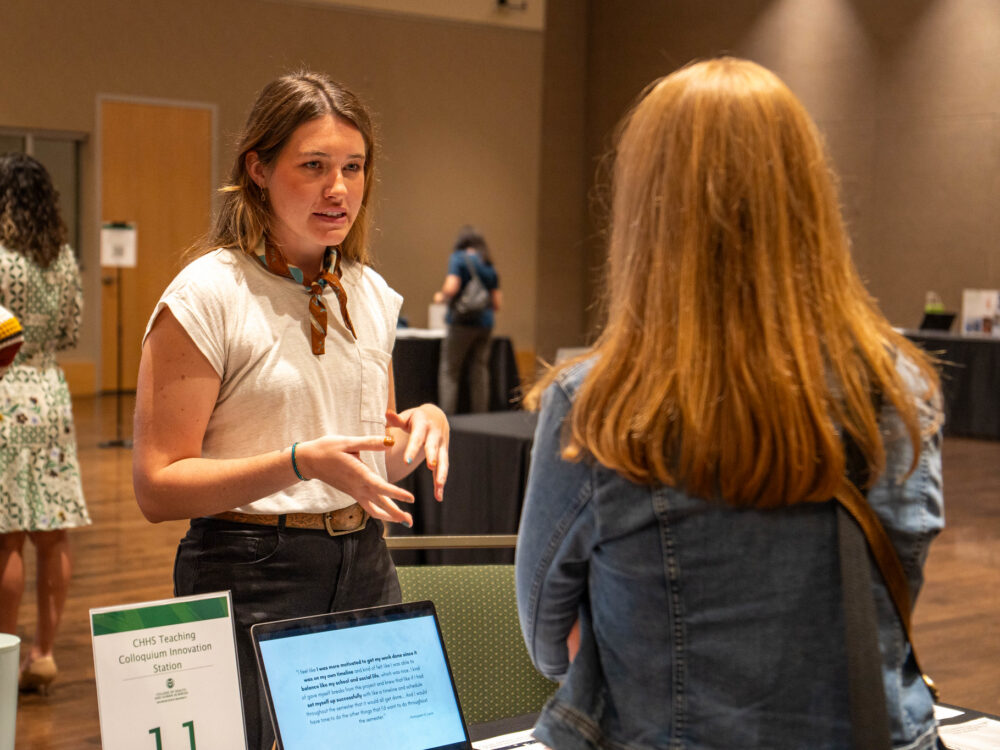
Teaching Innovation Station Presenters
Brittanie Ash | Meme-ingful Classroom Connections
Assistant Professor, Social Work
Meme-ingful Classroom Connections
Theme Selection and Alignment: Community Building and Classroom Climate
Innovation Description:
In today’s social work classrooms, educators are often challenged to design learning experiences that both foster community and promote meaningful engagement, especially around topics such as research or policy. One innovative approach is the integration of internet memes as a pedagogical tool. Memes are concise, often humorous cultural artifacts that can bridge communication gaps, invite creativity, and encourage students to connect course content to their own lives. By tapping into familiar, everyday digital media, memes help dismantle barriers to participation, reduce anxiety, and create a fun and shared classroom culture rooted in playfulness and collaboration.
This station will explore the use of memes in a social work research course to build community while supporting academic achievement related to qualitative methods. It will highlight a lesson in which students create memes to illustrate concepts in qualitative methods, such as coding and thematic analysis. By translating complex ideas into accessible, visual humor, students deepen their conceptual understanding while also having fun and building community with one another.
Impact on Student Learning:
My observations of doing this activity show that incorporating memes enhances student motivation, encourages knowledge retention, and fosters a sense of belonging. Beyond their entertainment value, memes serve as low-barrier entry points into rigorous discussion and critical thinking.
This approach demonstrates how play and scholarship can coexist in the classroom, ultimately creating a learning environment where students are both challenged and supported. Integrating memes into teaching not only sparks joy but also strengthens academic and social connections essential for student success.
Christopher Beuret | Teach It Like They Learn It
Instructor, Construction Management
Teach It Like They Learn It
Theme Selection and Alignment: Feedback and Assessment
Innovation Description:
This teaching strategy invites educators to reflect on how instructional methods align with students’ preferred learning styles. At my booth, participants will engage in a hands-on activity: tying a bowline knot. The objective is simple, but the delivery is varied—four stations represent auditory, visual, reading/writing, and kinesthetic learning styles. Participants choose a station and attempt the task using that style.
This strategy connects to the conference theme of “Feedback and Assessment” by prompting educators to assess not just student outcomes, but the effectiveness of their teaching methods. It models how instructional design can be adapted to meet the learner’s needs, rather than defaulting to a single style. This specific activity is grounded in behavioral learning theory, which supports hands-on and visual instruction for procedural tasks, and I will outline some other teaching styles as well. This approach encourages educators to consider how learning outcomes improve when teaching is intentionally matched to how students learn best.
Impact on Student Learning:
This strategy demonstrates how aligning teaching methods with the most effective learning style can help a greater proportion of students meet learning objectives. In this hands-on activity, participants attempt to tie a bowline knot using one of four instructional styles. I theorize that those taught through hands-on or visual methods will more successfully meet the objective, because the method matches the task.
This illustrates a key principle: teaching should be dynamic and responsive, not static. As educators, we must continually assess and adjust our methods to support student success. This means reevaluating our default styles and choosing approaches that best fit the content and the learners. When instruction is tailored appropriately, more students reach the goal—not because they’re “better” learners, but because we’re better teachers. This exercise invites educators to reflect on how intentional shifts in teaching strategy, guided by ongoing assessment, can lead to more equitable and effective learning outcomes.
Tonya Buchan | Reflection as a Tool to Demonstrate Learning and Growth

Senior Faculty Developer & Teaching Effectiveness Initiative Program Manager | The Institute for Learning and Teaching
Reflection as a Tool to Demonstrate Learning and Growth
Theme Selection and Alignment: Feedback and Assessment
Innovation Description:
Reflection is a powerful tool to demonstrate student learning as well as instructor professional growth. Engaging in reflective practice provides an opportunity for learners to pause, intentionally review the experience, make connections, and shape decisions. The CSU Teaching Effectiveness Initiative (TEI) Program incentivizes instructors to engage in scholarly teaching through the implementation of and reflection upon the use of evidence-based practices of the Teaching Effectiveness Framework (TEF).
Impact on Student Learning:
The TEI Program and the TEF are designed to support faculty committed to student success by taking a scholarly approach to teaching. According to the 2023 Civitas Learning Student Success Impact Report, incentivizing faculty use of evidence-based practices typically has a positive influence on student success and persistence. The TEI Program’s focus on the evidence-based practices highlighted in the TEF provides a comprehensive, easy-to-use resource grounded in the science of teaching and learning.
Additionally, self-reflection is a powerful tool for both faculty and students as it provides an opportunity to think critically, make connections between prior and new knowledge, and grow. Review exemplary post-implementation reflections from the TEI program to see how instructors self-assess their instructional practices and the impact on student learning. Additionally, consider how instituting a reflective practice in your classroom can foster critical thinking and growth.
Kimber Finan | Exams as Learning Opportunities, Not Just Assessment
Senior Instructor, Health and Exercise Science
Exams as Learning Opportunities, Not Just Assessment
Theme Selection and Alignment: Feedback and Assessment
Innovation Description:
We often think of exams primarily as a way of assessing student learning, but what if students could also learn while taking exams! I utilize a simple, easy-to-implement strategy of second-chance testing that promotes student learning, facilitates connection and discussion, and maintains the incentive to study and prepare well for exams. Students take a typical closed-book exam on one class day (“Part 1”). Then, this is followed up with an open note, group part of the exam the next class day (“Part 2”). In Part 2, students retake the most frequently missed questions on the exam in small groups in an open-book, open-note format.
The instructor and TAs wander around to answer questions and provide guidance. During Part 2, we see learning in action because students are discussing, explaining to each other, defending their answers, and asking questions. Part 2 is primarily intended to help students learn, but also has a positive impact on most students’ grades. I combine the two parts of the exam for an overall exam grade, with Part 1 typically making up ~75% and Part 2 typically making up ~25% of their total exam score. There are many different variations of what this second chance testing could look like, but based on student feedback, it’s clear students enjoy Part 2, find it helpful for learning, have a sense of decreased stress about exams, and appreciate being able to ask the instructor and TAs questions. Let’s brainstorm ways to make exams into learning opportunities!
Impact on Student Learning:
This form of second-chance testing motivates students to study and prepare well for Part 1 of the exam, which I have seen play out with great engagement in office hours, review sessions, and in-class review activities. But then also harnesses additional active learning strategies by encouraging student discussion, debate, and questions on Part 2. I have seen many “aha” moments during Part 2 of the exam, as students see concepts come together or recognize small misconceptions through discussion with each other, myself, or TAs. It also gives students another way to demonstrate their knowledge, reducing stress about exams, and allowing those students who may struggle with typical exams to have a way to improve their grade and demonstrate their knowledge through Part 2.
Sampling of student feedback about Part 2:
- I really love it, it allows me to check answers with my peers to see if we are both grasping the content. It also provides extra help on topics we may not have understood during the exam.
- I think it helps me understand confusing topics better, and I like how I can get help from TAs
- I love being able to talk about challenging concepts on the test and it helps the information stick with me better. I love that we can talk through concepts with our classmates.
- I find them really helpful. Being able to workout what we did wrong with groups and correct them is really great for learning/understanding content better. It does help me connect with classmates better.
Chris Geanious | Using Self-Assessments to Promote Growth and Realistic Self-Appraisal

Senior Instructional Designer | The Institute for Learning and Teaching
Using Self-Assessments to Promote Growth and Realistic Self-Appraisal
Theme Selection and Alignment: AI and Technology
Innovation Description:
This Innovation Station invites faculty to explore strategies to integrate generative AI into their courses.
Impact on Student Learning:
This innovation will help students understand how AI is to be used in a course and guide them in the responsible, ethical use of AI in assignments.
Katie Gerst | Flipped Micro-Lectures with AI: Maximizing Class Time for Engagement and Application
Associate Professor, Human Development and Family Studies
Flipped Micro-Lectures with AI: Maximizing Class Time for Engagement and Application
Theme Selection and Alignment: AI and Technology
Innovation Description:
This teaching practice integrates AI-assisted flipped micro-lectures to maximize student engagement and active learning in class. Instead of using valuable class time for lengthy lectures, I create short, focused video lessons with the help of AI tools such as ChatGPT, Napkin.ai, or Notebook LM. These tools assist in generating clear outlines, scripts, and even video narration, making the production process efficient and sustainable.
Each micro-lecture highlights a single key concept or skill and is kept under ten minutes to maintain attention. Videos can incorporate AI-generated visuals, captions, or comprehension checks to enhance accessibility and reinforce learning. Students watch the micro-lectures before class, arriving with a shared baseline of knowledge. Class sessions then focus on application through activities such as case studies, small-group problem-solving, debates, and role plays that deepen understanding and encourage collaboration.
This teaching strategy connects directly to the AI and Technology theme by demonstrating how AI can streamline content creation while supporting more student-centered teaching. It also addresses common challenges of the flipped classroom model (time and workload for faculty) by reducing the effort needed to produce engaging, high-quality materials.
Impact on Student Learning:
AI-assisted flipped micro-lectures have improved student learning, motivation, engagement, and equity in my courses. By delivering concise video lessons before class, students come prepared with a shared baseline of knowledge. This allows in-class time to focus on application through case studies, small-group problem-solving, and discussions that strengthen understanding and critical thinking.
Students report that the short, targeted videos feel more approachable than traditional lectures. Because each micro-lecture is under ten minutes and often paired with a comprehension check, students are more confident in their grasp of key ideas, which increases motivation to participate in class activities.
Engagement is stronger when class time emphasizes collaboration and active learning. Students contribute more readily, ask deeper questions, and learn from each other’s perspectives. This shift transforms class from a passive to an interactive experience.
Equity is also enhanced. AI makes it easy to add captions and transcripts, improving accessibility for diverse learners. The videos remain available throughout the semester, allowing students to revisit material at their own pace. This flexibility ensures that students with different learning styles, schedules, or needs are equally supported. Overall, the practice fosters inclusion, active participation, and deeper learning.
Molly Gutilla | Learning Over Letters: Communicating Alternative Grading Designs to Grow Student Connection
Associate Professor, Colorado School of Public Health at CSU, Health and Exercise Science
Learning Over Letters: Communicating Alternative Grading Designs to Grow Student Connection
Theme Selection and Alignment: Community Building and Classroom Climate
Innovation Description:
Alternative grading practices can help students focus more on learning and less on point-chasing, but these systems only work when students understand how and why they’re being used. This Teaching Innovation Station highlights the importance of communication when implementing alternative (or traditional) grading. Clear, consistent messaging helps students feel more confident, supported, and engaged throughout the semester.
The station will feature practical communication tools including syllabus language, onboarding activities, grading visuals, and mid-semester check-ins. These strategies are designed to help instructors explain their grading systems in ways that encourage student buy-in, reduce confusion, and support a positive classroom environment.
Impact on Student Learning:
When students understand how they’re being assessed and why it matters, they are more likely to stay motivated, ask for help, and take academic risks. Communicating grading design clearly helps students feel more connected to their instructor and the course content, creating a learning environment where students can stay focused, grow, and succeed.
Alison Herman | Ditch the Discussion Board – Effective Use of a Peer Mentoring Model
Associate Professor, Academic Fieldwork Coordinator, Occupational Therapy
Ditch the Discussion Board – Effective Use of a Peer Mentoring Model
Theme Selection and Alignment: Community Building and Classroom Climate
Innovation Description:
Discussion boards are an integral feature of the Canvas platform and are used frequently during classes and when students are on internships and fieldwork placements. The discussion board should serve as a platform for students to reflect on their experiences, ask questions, and receive feedback from peers and instructors, fostering a collaborative learning environment and helping to bridge the gap between the academic environment and real-world practice. In their 2014 study on graduate student perceptions of discussion boards, Amos identified several characteristics, such as being unnatural, busywork, boring, and lacking meaningful interaction. Amos (2014) also shared that when comparing live communication meetings vs. the discussion board, 74% of students preferred synchronous online communication vs. 24% for the asynchronous discussion board.
To increase collaborative learning among occupational therapy (OT) graduate students while on their fieldwork experiences, the asynchronous discussion board was removed, and an online Peer Mentoring model was established. Students are pre-assigned a small group and provided instructions and prompts to facilitate conversation. Student groups meet 3 times during the internship semester, record their meetings on Teams, and post their meetings for faculty to review and provide feedback. This shift in the discussion board model provides the opportunity for engaging dialogue, real-time feedback support, and connectedness among students.
Impact on Student Learning:
Following the implementation of an online Peer Mentoring model, student comments on course reviews have been positive. The transition from an asynchronous discussion board model to a synchronous peer-to-peer model provides students the opportunity to pose questions they might otherwise hesitate to ask their fieldwork educators, due to concerns about being perceived as incompetent.
Having live, real-time feedback is beneficial compared to posting on a discussion board and waiting for a response, especially when immediate support is needed. Students report that live meetings offer more natural and human connections, in contrast to the more robotic experience of the discussion board. Furthermore, having opportunities for students to connect with peers fosters the development of professional collaboration, a skill OT students will need as they transition from student to practitioner.
While the feedback has been mostly positive, some students with robust OT peer social groups outside of fieldwork have reported they do not rely on Peer Mentoring for collaboration, compared to others who don’t have this support. In addition, students whose preferred communication style is written vs. verbal may find the Peer Mentoring model intimidating and challenging. A study to evaluate the Peer Mentoring model would be beneficial to gather additional evidence and determine the effectiveness of this model vs. other models of online engagement.
Sara Istre | Assignments for Student Success
Career Education Manager, College of Health and Human Sciences | CSU Career Center
Expanding Career Education in Canvas: New Modules and Assignments for Student Success
Theme Selection and Alignment: AI and Technology
Innovation Description:
The Career Education Canvas Modules provide plug-and-play resources for faculty to integrate career preparation into their courses. Modules include Resumes, Cover Letters, Job Search Strategies, Career Center Resources Overview, and Introduction to Handshake.
Upcoming modules and assignments will provide faculty with ready-to-use, accessible activities that help students apply what they learn in the modules to their own career development. This strategy aligns with the AI and Technology theme by utilizing Canvas as a central platform for accessible, scalable learning, while also providing flexibility for faculty to embed and customize content tailored to their specific course needs.
Impact on Student Learning:
Integrating career modules into the classroom makes career education more accessible to all students, reducing barriers and ensuring that they are better prepared for internships and job searches. With the addition of assignments, students will not only learn about career preparation but will also practice and receive feedback on tangible materials (e.g., resumes, cover letters, interview responses), further boosting engagement and readiness.
By embedding this content directly into Canvas, all students—regardless of their major or year—gain equitable access to professional development resources that connect classroom learning to their future careers.
Kevin Kissell | The Recycled Wearables Collaborative Project and Exhibition
Assistant Professor, Design and Merchandising
The Recycled Wearables Collaborative Project and Exhibition
Theme Selection and Alignment: Community Building and Classroom Climate
Innovation Description:
AM 130: Awareness and Appreciation of Design is an AUCC Category 3B course designed to explore uniquely human expressions. This course is a survey of how art and design practitioners make use of the elements and principles of design.
These courses are quite large, and students run the risk of being lost in a sea of faces. The Recycled Wearables project allows students to apply the knowledge learned in class and create a wearable object made from recycled materials in a collaborative manner.
Impact on Student Learning:
In small, randomly selected groups, students begin by developing their strategy. This includes an initial meet-and-greet, selecting a project manager, creating a communication plan, discussing individual skill sets, and building a production calendar.
Next, students collaborate to brainstorm ideas, connecting course outcomes to the concept for their final wearable object. This stage typically involves image gathering, collaging, and sketching.
Once a concept is established, students begin sourcing materials. At least 95% of the materials must be recycled, reused, or discarded items. Students are encouraged to search recycling bins, their closets, or collect leftover copies of The Collegian!
With materials collected, the construction phase can begin. Some students bring sewing or building skills to the table, while others may not. This project challenges each group to think creatively and leverage their members’ unique strengths. Often, teams develop a natural synergy—one student may cut materials, another assembles pieces, and another sews the final seams.
The project culminates in a gallery exhibition. Students showcase their wearable objects on mannequins, distribute promotional materials, and participate in a formal opening attended by the public. This moment marks the reward for their collaboration and effort.
Jen Krafchick | Strategies for Supporting Students' Well-Being
Professor, Human Development and Family Studies
Strategies for Supporting Students’ Well-Being
Theme Selection and Alignment: Community Building and Classroom Climate
Innovation Description:
Campus Connections (CC) is a mentoring program for community youth and a service-learning course for college students. The innovative CC design includes multiple strategies to attend to the well-being of youth mentees and college student mentors. Many of these strategies can be transferred to other types of courses and learning environments.
The strategies to attend to the well-being of college students such as leadership opportunities, emotion coaching, attunement to the individual, and being part of a supportive community. These strategies can be implemented in other courses. This connects to Community Building and Classroom Climate by implementing strategies to support college students by building connections to peers and developing leadership skills.
Impact on Student Learning:
Research demonstrates the effectiveness of these strategies. Findings of two studies will be presented that highlight the efficacy of the strategies. Study #1 is a recent quasi-experimental study comparing students who participated in CC as mentors with those who did not (N=533) include improved flourishing, self-compassion, and well-being.
Study #2 outcomes demonstrate improved student success indicators (higher persistence and graduation rates, faster degree completion, and higher GPAs). Attending to both academic success and well-being for students participating in service-learning is imperative as campuses support the next generation of engaged professionals.
Alex Lange | Using Self-Assessments to Promote Growth and Realistic Self-Appraisal
Associate Director, Assistant Professor & Higher Education Programs Coordinator, Education
Using Self-Assessments to Promote Growth and Realistic Self-Appraisal
Theme Selection and Alignment: Feedback and Assessment
I will share my practice focused on student engagement self-assessments. To help bolster students’ realistic self-appraisal while also providing them with individual feedback, graduate students in my courses complete a self-assessment related to course engagement and learning. I administered the assessment twice during the semester–one at the midpoint and one at the end — to help students reflect on their engagement in the course thus far, collect feedback for myself about what is working and what is not working in the course, and help students identify ways that they can better take charge of their learning.
This relates to the feedback and assessment theme quite directly, as it is a strategy of both assessing the course thus far and getting feedback from students in ways that help me direct feedback for their remaining time in the course (at the midpoint) and help them identify strategies for success in future courses (at the endpoint).
Impact on Student Learning:
The assessment I administer uses a Plus/Delta model of course assessment. In addition to questions such as “What is the instructor doing well to help your learning in the course?” and “What can the instructor do differently to support your learning?” The assessment also asks questions like “What are you doing to maximize your learning in this course?” and “What can you be doing differently to better support your learning in this course?”
These questions have helped prompt students to identify the behaviors and actions that are supporting their learning and motivation, and helps me identify different engagement strategies in synchronous and asynchronous formats. After students complete this self-assessment, I provide each of them with about 4 to 5 sentences worth of feedback, both of affirming what I see as working and encouraging them to try new things or strategies to enhance their learning before, during, and after class as applicable.
Greta LeDoyen | Using Assignments to Improve Well-being
Instructor, Health and Exercise Science
Using Assignments to Improve Well-being
Theme Selection and Alignment: Feedback and Assessment
Innovation Description:
The assignments we give can positively impact student well-being. This is evidenced by a class project I assign in an undergraduate Health Behavior Theory course for primarily HES majors. The course progresses from individual theories, to social theories, and concludes with application through health promotion planning models. The assignment takes place during the final four weeks, immediately after students learn the PRECEDE/PROCEED Model (PPM).
Students apply the PPM to design and implement a personal stress-reduction intervention, including SMART behavioral goals and a tracking system. Pre-intervention measures include the Perceived Stress Scale and the Academic Anxiety Scale.
At the two-week mark, students complete a Process Evaluation to identify additional influencing factors and adjust goals and tracking methods based on their experience. At week four, they submit an Impact Evaluation, including behavior completion rates, post-intervention stress and anxiety scores, and written reflections comparing pre- and post-results. The instructor aggregates class results and highlights common themes. Each of the three assignments are graded with formative feedback provided within one week of submission.
This approach integrates authentic assessment, self-reflection, and iterative goal-setting, enabling students to apply theoretical frameworks to their own well-being while generating data that shows the assignment has a positive impact on student stress and academic anxiety.
Impact on Student Learning:
This authentic assessment measured students’ understanding of the PRECEDE/PROCEED Model rather than their success in meeting personal goals—yet most surpassed expectations. Across four weeks, 88% reported achieving at least 50% of their stress-reduction goals, and 54% achieved 75% or more. Designing interventions for their own well-being fostered personal investment, intrinsic motivation, and sustained engagement.
Midpoint process evaluations prompted students to identify new stress factors, adjust SMART goals, and refine strategies, deepening their critical thinking and adaptability. Final reflections demonstrated strong connections between theory and practice, with students using course concepts to explain both successes and challenges.
Aggregated results shared with the class sparked discussion and reinforced learning. By linking academic content to personal relevance, this practice increased motivation, supported equitable participation across diverse backgrounds, and enhanced students’ confidence in applying theory to real-world health challenges.
As one student wrote, the project “made me feel productive, useful, and energized mentally.”
Christina Minihan | Fostering Community & Service- Learning Experiences Through a Student-Run Platform
christina.minihan@colostate.edu
Associate Professor; Hospitality and Event Management, Food Science and Human Nutrition
Fostering Community & Service- Learning Experiences Through a Student-Run Platform
Theme Selection and Alignment: Community Building and Classroom Climate
Innovation Description:
A significant aspect of my teaching approach includes fostering community and service-learning experiences. One way this is delivered within my courses is through a student-run account called csu_hemadventures. The goal of this page is to promote our HEM major and build community. While I use this page in two HEM classes, it is also a platform open for the entire HEM family to post their HEM adventures and engage peer-to-peer. The two courses that use this page frequently are Hospitality Marketing & Culinary Tourism.
The learning objectives related to the page are the following: To promote our HEM family/major through authentic peer-to-peer engagement. To provide service-learning opportunities by promoting students’ favorite local businesses and creating collaborative opportunities. To provide students with a hands-on, authentic learning tool that helps them learn social media management and strategy. To highlight student life, such as HEM classes, events, and other important aspects of the HEM program from the lens of students. One of the goals of this page is to help students experience the impact of building an account from the ground up. It is a space for students to not only make their own mistakes and learn from them, but also see the positive outcomes of their hard work. For example, since the inception of this page (Fall 2023), the students gained over 600 new followers. These followers are not only from students, but also key industry players in the hospitality field.
Impact on Student Learning:
Students have been connecting with these industry players, resulting in new relationships that create collaborative opportunities of networking and the possibility of obtaining new jobs. Some of the student followers even changed their major as a result of the authentic content the HEM students created and also signed up for courses they did not know existed. They also saw the positive difference they are making in the community! For example, the students created an ongoing campaign called HEM Saves, which involves collaborating with local businesses and developing a promotion to help attract new customers.
Their very first HEM Saves with Pizza Casbah was a huge success. The students generated 100 new customers as a result of their campaign! This was a testament to how HEM students can come together and successfully market a local business. It was so rewarding to see them realize the positive impact they can make. There are so many benefits I have witnessed as a result of this page as I have highlighted above. However, being a part of this page has allowed students to build confidence and obtain important digital marketing skills and experience. It also provides them with a platform to showcase the creative work they are capable of. For example, outside of the classes, we have developed a leadership team that helps monitor the page and ensure we stay within the page goals and learning outcomes. Last semester, the leadership team started a cooking show where they featured President Parsons!
Delaney O'Brien | Standards-Based Grading in Project-Based Majors
Master’s Student, Design and Merchandising
Standards-Based Grading in Project-Based Majors
Theme Selection and Alignment:
Feedback and Assessment
Innovation Description:
The standards-based grading (SBG) approach is being piloted in a senior-level capstone course where students have identified their own site, typology, and user groups to design a complex and research-informed interior design solution. With this baseline of individual autonomy, the course grading scheme is based on the SGB approach, where course learning objectives have been transformed into a series of clearly defined outcomes. These banded outcomes are shared with students as ones that need to be evidenced in the final submission by the end of the semester. Formative feedback, as an essential element of SBG, occurs throughout the semester as students submit work for instructor feedback.
At key submissions, the instructor shares progress toward each outcome on a four-point scale of beginning, developing, meeting, or exceeding. Students are receiving in-depth qualitative feedback and tracking their progress toward meeting each outcome as the semester progresses. This approach allows students to achieve outcomes on the timeline that makes sense for their unique project and process – instead of being penalized for a missing rubric element earlier in the semester.
Impact on Student Learning:
Students were generally positive about the grading practices, but some also shared their struggles with not having a precise numerical score at key course milestones. After a pilot study conducted in Fall 2024, SBG is showing benefits as an emerging method for grading and feedback. The pilot study was assessed through surveys and interviews with thematic coding. The surveys and interviews track similarly, benefiting across the board for student experience and student success. Students benefit through flexibility, motivation, mental health, and depth of learning.
Students are less stressed about their grade throughout the semester and more focused on connecting with their instructor to learn the needed skills and produce as needed for success. Students are showing agreement with generally liking this grading system, mental health benefits, and feelings of ownership over the project. Some students still feel nervous about not having a grade to check in Canvas. This study is planned to occur in the near future to gain a larger sample size and increase understanding of this method. Overall, students noted appreciation for the trust and flexibility extended to them, which contributed to the student-centered atmosphere of the course.
Lily Ortega | Community Building in Asynchronous Online Teaching through “Water Cooler Discussions”
Associate Professor, Human Development and Family Studies
Community Building in Asynchronous Online Teaching through “Water Cooler Discussions”
Theme Selection and Alignment: Community Building and Classroom Climate
Innovation Description:
Building community in an asynchronous classroom can be challenging. One low-stakes strategy I use is having connection-focused “water cooler” discussions packed into the first few weeks of the course. After the first four weeks of the semester, I find that students participate and interact more in the content-heavy discussions and through office hours!
The “water cooler” discussions involve asking a super quick discussion question that students can respond to and provide a handful of replies to other students within a 5–10-minute time frame. One goal is for these to take no more than 10 minutes (similar to the in-person informal interactions students would have before/after an RI class). I purposely front-load these discussions to help create a community and connection so that when we get to peer reviews or more content-heavy discussions, students know more about each other, feel more comfortable with each other, and are more willing to engage in deeper discussions with one another.
Impact on Student Learning:
I have noticed that in classes where I have “water cooler” discussions, students are more engaged in coursework that requires working with peers or interacting with the instructor/TAs (discussions/peer reviews/group or partner projects and office hours).
Student participation in the “water cooler” discussions correlates with more engagement in the content-heavy discussions (replying to more peers and with more detailed, in-depth replies) and submission of other assignments on time. Students also seem to attend office hours at a higher rate in classes with “water cooler” discussions, which might indicate that they feel more comfortable in the class. A few students have shared that they enjoyed learning about and connecting with peers on the course surveys.
Rick Perry | Using AI to Enhance Student Learning While Reducing Instructor Workload
Senior Instructor, Health and Exercise Science
Using AI to Enhance Student Learning While Reducing Instructor Workload
Theme Selection and Alignment: AI and Technology
Innovation Description:
My teaching practice uses generative AI as both a learning catalyst and an assessment partner. In summer 2025, students created integrative reviews that combined lecture material, homework, and research papers on topics of personal interest. They used Notebook LM, a source-constrained AI, to analyze research, and generative AI to develop narratives. Final products included written and presented work, requiring critical thinking and synthesis across sources.
I address grading challenges from individualized projects by using AI to review submissions for accuracy, source fidelity, and integration of course content, creating a scalable, rigorous model for advancing students through higher levels of Bloom’s Taxonomy.
Impact on Student Learning:
Student Learning – Students demonstrated substantial progression to higher levels of Bloom’s Taxonomy, integrating content knowledge and synthesizing written and verbal outputs to showcase deep cognitive understanding.
Motivation & Engagement – Allowing students to connect course content with their personal interests fostered meaningful application and relevance, enhancing both intrinsic motivation and professional alignment.
Equity – Detailed rubrics, clear instructions, and comprehensive Canvas resources ensured all students had equitable guidance on how to effectively use AI tools to achieve success in the course.
James Peth | Teaching in the Age of Answers: Designing for Thoughtfulness, Integrity, and Feedback
Assistant Professor, Food Science and Human Nutrition
Teaching in the Age of Answers: Designing for Thoughtfulness, Integrity, and Feedback
Theme Selection and Alignment: AI and Technology
Innovation Description:
In my nutrition and wellness coaching courses, I have developed an integrative instructional design approach that uses AI to support academic integrity, learning, and responsible AI engagement. From the outset, AI helps me refine instructions, rubrics, and assessments that set transparent expectations and embed reflection. A central innovation is the redesign of online discussions. Moving beyond the “post once and reply twice” model, students must describe their research process, synthesize credible sources, and apply course concepts to real-world and personal contexts. Replies extend conversations by comparing perspectives, questioning assumptions, and citing literature where appropriate, which builds habits of sustained, meaningful interaction.
Quizzes were also redesigned from multiple-choice to matching formats aligned with Bloom’s taxonomy. Unlike multiple-choice, which could be copied into AI for quick answers, matching uses drop-down menus that require students to carefully read and analyze. Draft questions are generated with AI but refined for rigor, accuracy, and alignment with outcomes. Together, these elements form an integrative pathway—readings, quizzes, lectures, discussions, and exams—that promotes integrity, reflection, and authentic engagement while modeling appropriate AI use.
Impact on Student Learning:
Placing integrity and learning at the center has reshaped student engagement. In discussions, requiring research-process explanations necessitates more original, evidence-based posts, helping students practice and develop confidence in evaluating information from the academic literature. The redesigned rubric makes expectations explicit, rewarding synthesis, application, and sustained interaction rather than surface-level participation.
Matching-style quizzes have raised rigor while eliminating copy-paste shortcuts, requiring both understanding and application, and multiple attempts support retrieval practice and mastery. Rubrics refined with AI have provided students with clearer guidance and made feedback more consistent. Collectively, these strategies were designed to create a culture where students see AI not as a way to bypass learning, but as a professional tool that can support authentic work, critical thinking, and academic integrity across all levels of study.
Marla Roll and Melanie Eddigton | Using Self-Assessments to Promote Growth and Realistic Self-Appraisal
Director, Assistive Technology Resource Center (ATRC), Associate Professor, Occupational Therapy
melanie.eddington@colostate.edu
Client Services Provider, Assistive Technology Research Center
Using Self-Assessments to Promote Growth and Realistic Self-Appraisal
Theme Selection and Alignment: AI and Technology
My practice focuses on fostering equitable access to learning through the use of assistive technology (AT). At CSU’s Assistive Technology Resource Center, we connect students with a wide range of assistive technology tools, some incorporating AI, that support areas such as reading, writing, note-taking, studying, organization, and time management. While these tools are regularly utilized to reduce barriers for students with disabilities, they also have universal application and benefits. Many students, regardless of diagnosis, face challenges with breaking down complex tasks, meeting deadlines, or comprehending dense readings.
With training in utilizing assistive technology and, at times, AI , these technologies can enhance academic participation for all learners. This approach aligns with the theme of AI and technology by highlighting how emerging tools can extend beyond accommodations to broadly enhance learning. AT is not limited to specialized use, but can instead serves as a bridge to increase confidence and efficiency in academic work for all learners. Students may utilize text-to-speech tools to support reading comprehension, dictation or mind mapping software to streamline writing, or digital organizers to structure projects. These tools normalize the use of AT, creating an inclusive and supportive environment where students are encouraged to explore and adopt strategies that fit their needs.
Impact on Student Learning:
Assistive technology provision significantly improves student learning, engagement, and equity by ensuring that all learners have access to tools that match their academic needs. At the Assistive Technology Resource Center, we collect student surveys each semester along with standardized assessments at the beginning and end of service provision to measure outcomes. These measures consistently demonstrate that students benefit from the use of assistive technology. Reported outcomes include less procrastination, increased reading comprehension, and greater satisfaction with academic participation, among many others.
Students describe feeling more confident and independent in managing their coursework. Because the tools directly target common challenges such as organization, time management, and comprehension, students become more efficient in all areas of their academic work. They spend less time struggling with barriers and more time meaningfully engaging with course content. The use of AI-supported and assistive technologies fosters equity by providing all students, whether or not they have a disability diagnosis, opportunities to adopt strategies that enhance their success. Ideally, this results in more active, engaged learners who are equipped with the skills and tools to complete their coursework more effectively.
Sherona Saraji Simpson | Student Engagement through Active Learning
Instructor, Construction Management
Student Engagement through Active Learning
Theme Selection and Alignment: Community Building and Classroom Climate
Innovation Description:
I use active learning techniques that encourage students to engage directly with course content through practice, collaboration, and reflection. Activities are carefully scaffolded so that students first develop proficiency with foundational concepts before progressing to more complex applications.
Instruction is structured around authentic, discipline-appropriate tasks (e.g., work breakdown structures, quantity takeoff, cost assembly), ensuring that students can connect theory to practice. Learning is reinforced through multiple modalities, including video analysis, physical models, group problem-solving, and applied estimating exercises. These strategies foster deeper understanding, support knowledge retention, and allow students to build confidence in both technical and collaborative skills as they advance through progressively challenging material.
Impact on Student Learning:
After completing this exercise, students demonstrate greater confidence in their ability to independently perform quantity takeoffs, even for trades that were not explicitly covered in class. They also value being introduced to assemblies estimating, a concept that prepares them for success in the subsequent Construction Estimating course.
Beyond these outcomes, the activity strengthens their problem-solving skills by requiring them to apply prior knowledge in new contexts, reinforces collaboration through group work that mirrors industry practice, and builds their capacity to synthesize information across different sources (video, drawings, physical models). Students also gain a clearer understanding of the estimating process as an integrated workflow, which helps them transfer skills more readily to future projects and professional settings.
Julie Taylor-Massey | Peer Observation Program
Master Instructor; Online Programs Student and Teaching Success Coordinator, Human Development and Family Studies
Peer Observation Program
Theme Selection and Alignment: Feedback and Assessment
Innovation Description:
I will showcase, and invite faculty to participate in, the Peer Observation Program. The Peer Observation Program provides a structured and effective way to engage in a supportive peer observation process, while encouraging sharing of teaching expertise and efforts toward teaching effectiveness for student success.
Ultimately, faculty who sign up will be paired, as well as provided with observation forms and guidance for proceeding through an efficient observation exchange, completed remotely. My goal during the Colloquium will be to increase awareness of this program and its benefits (including for annual review and promotion) and entice faculty to register for the fall session.
Impact on Student Learning:
The Peer Observation Program supports student success through an investment in effective teaching. It encourages faculty to use best practices that are grounded in scholarship and designed to improve student learning, such as those informed by the Teaching Effectiveness Framework. Moreover, it enhances teaching techniques through a supportive feedback exchange with a colleague. I have been facilitating the program for multiple years in HDFS and facilitated it for the college as part of my Teaching Fellow work last year. Feedback has been unanimously positive.
To quote former HDFS participants: “I am motivated to look at them [my courses] in new ways and make small changes that will make them a better educational experience for myself and students.” “I love the chance to peek into someone else’s teaching world – it’s a great way to find new inspiration and ideas from my very smart colleagues.”
Jennifer Todd | Teach to Your Strengths

Senior Faculty Developer & Teaching Effectiveness Framework Program Manager | The Institute for Learning and Teaching
Teach to Your Strengths
Theme Selection and Alignment: Community Building and Classroom Climate
Innovation Description:
This interactive station will begin with a brief activity to identify the evidence-based practices in the Classroom Climate domain of the Teaching Effectiveness Framework that instructors already integrate into their teaching. Then they will choose 1 – 3 practices in that domain that will create a greater sense of belonging and a supportive learning community.
Many instructors choose Classroom Climate as their strength and then realize that they do little to build student-student rapport, an integral part of classroom climate. This is an opportunity to promote student-student engagement.
Impact on Student Learning:
Building on strengths is an asset-based approach to learning that supports growth and development in students. The same can be applied to teaching. The intention is to begin with strengths in the Classroom Climate domain of the TEF and then suggest additional evidence-based practices in that domain to build on those strengths.
Anastasia Williams | Restorative practices to address microaggressions in your classroom

anastasia.t.williams@colostate.edu
Director of Teaching Excellence | The Institute for Learning and Teaching
Restorative practices to address microaggressions in your classroom
Theme Selection and Alignment: Community Building and Classroom Climate
Innovation Description:
Microaggressions in classrooms can fracture learning communities and silence student voices. Rather than relying on punitive responses that focus on punishment and blame, this teaching strategy employs restorative practices to rebuild relationships and foster understanding when harmful incidents occur.
Restorative practices reframe offensive behavior not as deliberate rule-breaking, but as breakdowns in community relationships stemming from lack of trust or empathy. This approach prioritizes safety, care, and healing over punishment, creating space for genuine learning and growth.
The strategy centers on guided conversations using specific restorative questions. For those who caused harm: “What happened? What were you thinking? Who has been affected?” For those harmed: “What impact has this had on you? What’s been hardest? What needs to happen to make things right?”
This process prioritizes six key elements: ensuring safety and care for all involved, providing support and education rather than punishment, offering information and choices about how to proceed, allowing space for grieving and expression of hurt, empowering voices that have been marginalized, and ensuring those harmed feel believed and vindicated.
By focusing on understanding consequences, exploring feelings and needs, and collaboratively determining paths to healing, restorative practices transform moments of harm into opportunities for deeper community building. Students learn to take responsibility for impact.